The biggest barrier to Industry 4.0 isn't technology; it’s the outdated beliefs holding your factory floor hostage.
If you walk into the average manufacturing plant today, you will experience a tale of two worlds. On the production floor (Operational Technology, or OT), life is measured in milliseconds, voltage, vibration, and the relentless pursuit of uptime. It’s a world of greased gears, legacy PLCs, and critical safety protocols.
Upstairs in the carpeted offices (Information Technology, or IT), life is measured in quarterly results, cloud APIs, cybersecurity compliance, and predictive models.
For years, the directive from the board has been clear: "Connect these two worlds. Achieve digital transformation." Yet, Gartner reports that nearly 80% of IoT projects fail before they ever reach scale.
Why? It isn’t a lack of budget, and it certainly isn’t a lack of available technology.
The failure stems from a fundamental misunderstanding of the problem.
If you want to bridge the gap between OT and IT, lets try to understand the fundamentals and debunk the myths.
The biggest lie told in manufacturing boardrooms right now:
"We don't need a digital transformation strategy; our existing SCADA system already collects all the data."
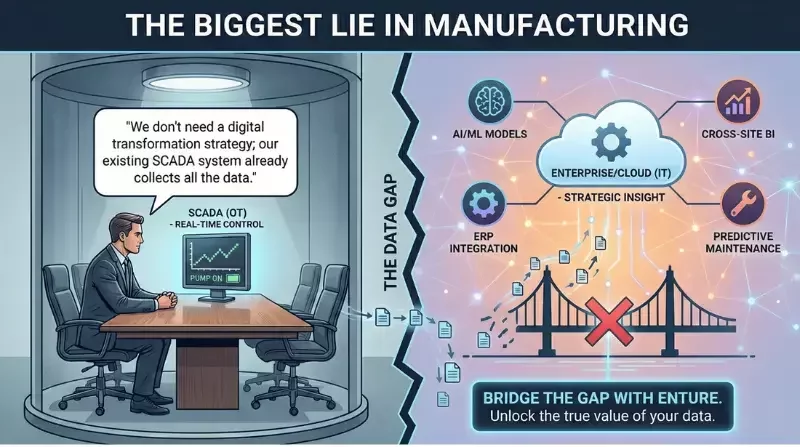
There is a pervasive sentiment on many factory floors that a digital transformation strategy is redundant because "our existing SCADA system already collects all the data." This viewpoint, often held by experienced operators and plant heads, stems from a misunderstanding of the fundamental difference between operational data for control and strategic data for enterprise intelligence. While it is true that SCADA systems are masters of real-time monitoring and control within the OT network, they were never designed to be data historians or analytics platforms for the wider business. Relying solely on SCADA for digital transformation frequently leads to data silos, as valuable information remains trapped in proprietary formats on local servers, inaccessible to modern IT tools like AI, machine learning, and cross-site business intelligence dashboards. Field experience shows that attempting to query a mission-critical SCADA network for massive amounts of historical data can lead to performance degradation, network flooding, and even production downtime—a risk no plant manager should take. A true digital transformation requires a dedicated layer that can safely extract, contextualize, and liberate this data from the SCADA environment without compromising its core function of keeping the plant running safely and efficiently.
Defining the Roles (OT vs. IT)
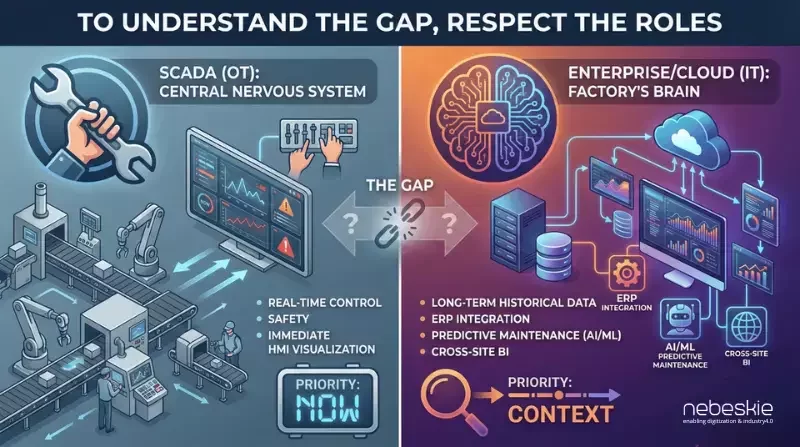
To understand the gap, you have to respect the roles.
SCADA (OT): The factory’s central nervous system. It's built for real-time control, safety, and immediate HMI visualization. Its priority is now.
Enterprise/Cloud (IT): The factory’s brain. It needs long-term historical data for ERP integration, predictive maintenance (AI/ML), and cross-site BI. Its priority is context.
To bridge the chasm between the factory floor and the boardroom, one must first respect the distinct, critical roles played by Operational Technology (OT) and Information Technology (IT). Think of the SCADA system as the factory's central nervous system; it lives in the immediate present, built for millisecond-level real-time control, ensuring operational safety, and providing instant visualization for operators on the HMI. Its priority is now—keeping the machines running and the lights on. Conversely, the Enterprise or Cloud environment is the factory's brain. It thrives on long-term historical data to fuel ERP integration, power predictive maintenance models through AI/ML, and generate cross-site Business Intelligence (BI). Its priority is context—analyzing past performance to optimize future strategy. The fundamental disconnect arises when we mistakenly try to force one system to perform the specialized function of the other.
The Square Peg in the Round Hole
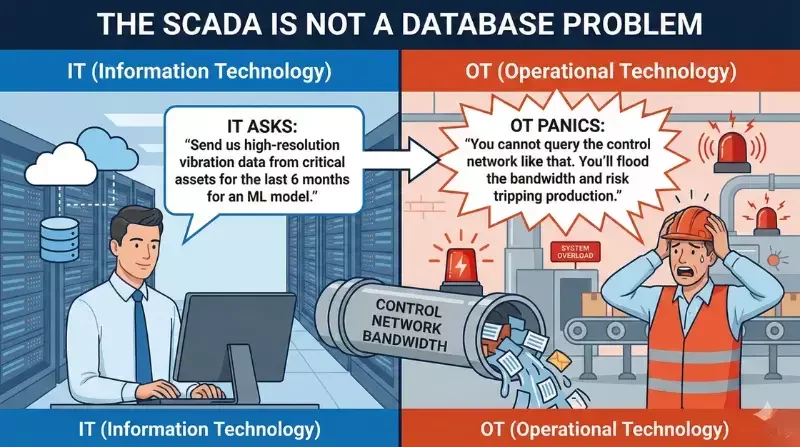
The problem arises when IT tries to treat SCADA like a modern database.
IT asks: "Send us high-resolution vibration data from critical assets for the last 6 months for an ML model."
OT panics: "You cannot query the control network like that. You'll flood the bandwidth and risk tripping production."
The friction reaches a breaking point when IT attempts to treat the delicate SCADA infrastructure as just another modern database to be mined. A classic scenario plays out like this: an IT team, eager to fuel a new machine learning model, requests "high-resolution vibration data from all critical assets for the last six months." While this seems like a standard query to the IT mind, it induces immediate panic on the factory floor. OT engineers know that you cannot subject a live, mission-critical control network to that level of heavy querying; doing so would flood the limited bandwidth, introduce dangerous latency into control loops, and pose a very real risk of tripping the entire production line offline.
Vibration data is the perfect example because it requires high-frequency polling (e.g., reading a sensor every 10ms). If you add that polling load to an older industrial network (like Modbus RTU over serial, or a saturated Ethernet/IP network), you will introduce latency. If the PLC misses its scan cycle time because the network is choked with IT data requests, the watchdog timer trips, and the machine shuts down.
The Language Barrier
It’s also a translation issue.
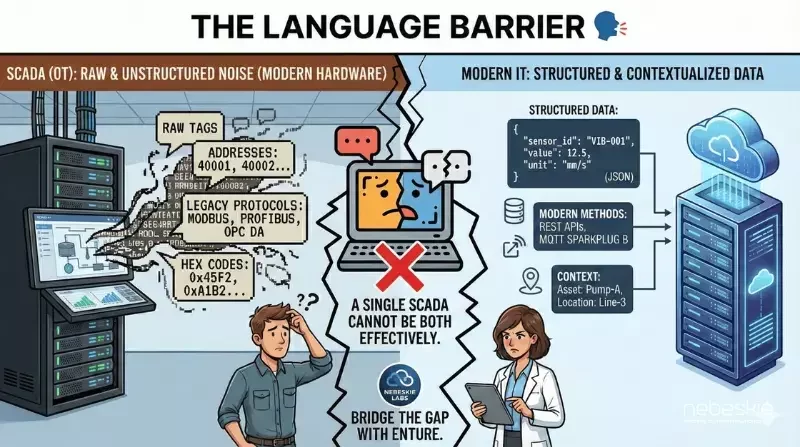
SCADA speaks in raw tags, addresses, and legacy protocols (Modbus, Profibus, older OPC DA). It’s unstructured noise to an outsider.
Modern IT systems need structured, contextualized data via modern methods (REST APIs, JSON, MQTT).
A single SCADA cannot natively be both things effectively.
Beyond the physical connection, a profound "language barrier" cripples communication between the shop floor and the top floor. SCADA systems natively speak in a dense, machine-level dialect composed of raw tags, obscure register addresses, and decades-old legacy protocols like Modbus, Profibus, or older OPC DA variants. To an IT developer or a cloud data scientist, this raw stream is essentially unstructured noise—numbers without meaning or hierarchy. Modern enterprise systems, however, demand structure and context; they crave clean, standardized payloads formatted in JSON and delivered via efficient modern transport methods like MQTT or REST APIs. Trying to force a single, traditional SCADA system to fluently speak both of these vastly different languages simultaneously is a recipe for failure; it simply cannot natively be both things effectively without a translation layer in between.
The Solution: Middleware for OT and IT integration
If SCADA can’t do it alone, and ripping everything out isn't an option, what is the answer?
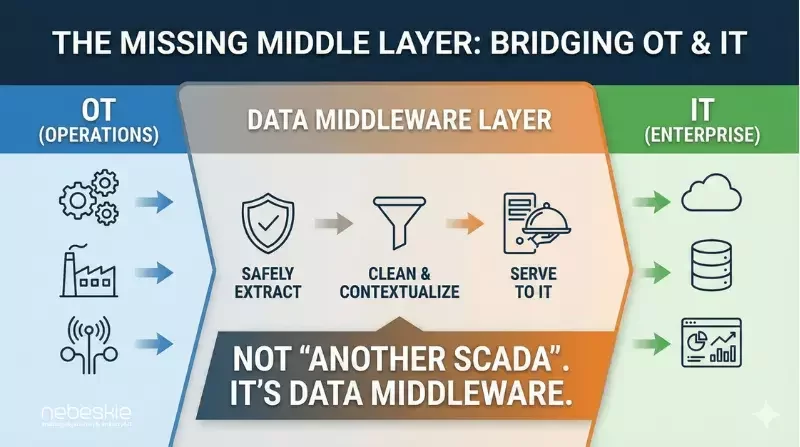
The answer is a dedicated Industrial Data Middleware layer.
You need a platform designed specifically to bridge the messy reality of the factory floor with the structured demands of the cloud. A platform that acts as a universal translator, a secure gateway, and a contextualization engine all in one.
This is why we built Enture.
Enture doesn't ask you to change your PLC logic or compromise your security. It connects to your existing, diverse assets—regardless of age or protocol—and provides a clean, unified stream of actionable data to whatever IT or BI system you choose.
The future of manufacturing belongs to those who can harmonize the greasy gears with the digital bits. It’s time to stop believing the myths and start building the bridge.