
Micros, Small, Medium, and Large Enterprises form the backbone of India’s industrial ecosystem. MSMEs alone contribute nearly 40% of industrial output, 40% of exports, and generate employment for over 120 million people, with a significant presence in rural India. Large enterprises, on the other hand, drive scale, exports, and global competitiveness.
Despite their critical role, enterprises across all sizes face a common set of challenges: rising costs, competitive pressure, shortage of skilled manpower, unpredictable downtime, and limited visibility into operations. In an era where margins are shrinking and customer expectations are rising, efficiency is no longer optional—it is essential.
This is where Industry 4.0 (I4.0) becomes a powerful enabler.
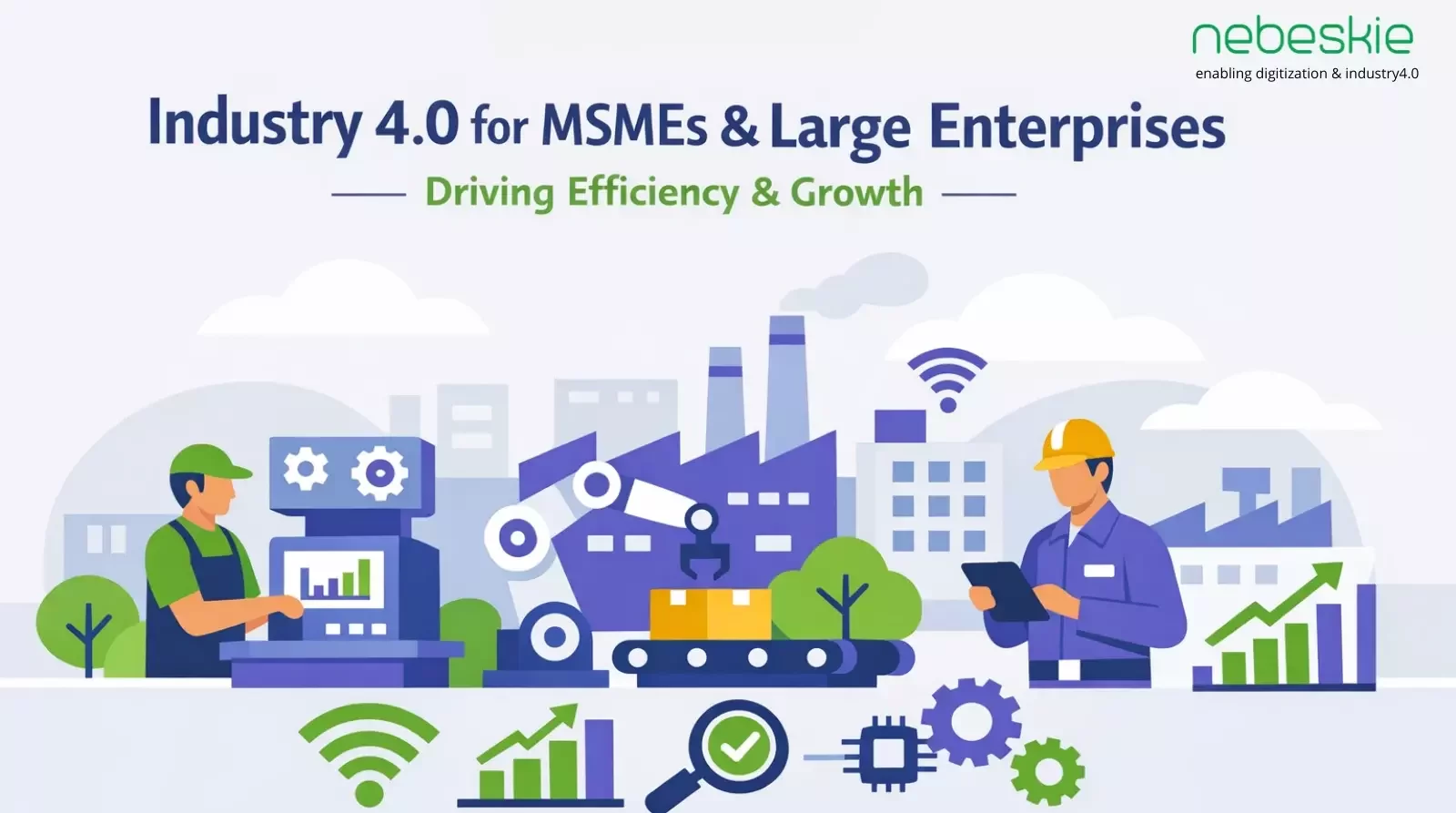
Doing More with Less
Across SMEs and large enterprises, the operational challenges are strikingly similar—only the scale differs.
Key challenges include:
- Inefficiencies in operations and productivity losses
- Difficulty in attracting and retaining skilled talent
- Limited resources and capital for training
- Limited access to finance and technology
- Unplanned downtime and rising maintenance costs
In a highly competitive market, companies must deliver high-quality products at lower costs, even with small batch sizes, limited budgets, and tight margins. Every unit of wasted energy, every idle machine, and every breakdown directly impacts profitability.
The fundamental question is: Can improving operational efficiency solve these challenges? And can Industry 4.0 make this transformation achievable and affordable?
Industry 4.0 is a Practical Reality, Not a Buzzword
Industry 4.0 is often misunderstood as automation reserved only for large enterprises. In reality, I4.0 is about data-driven decision-making, and even the smallest enterprise already has valuable data locked inside machines, meters, VFDs, PLCs, and control panels.
Today, more than 90% of SMEs in India still rely on manual monitoring, which is inefficient, delayed, and error-prone. Large enterprises, although more digitized, often suffer from siloed data, reactive maintenance, and hidden inefficiencies.
Industry 4.0—through IoT, analytics, and intelligent automation—bridges this gap.
Where Industry 4.0 Delivers Immediate Value
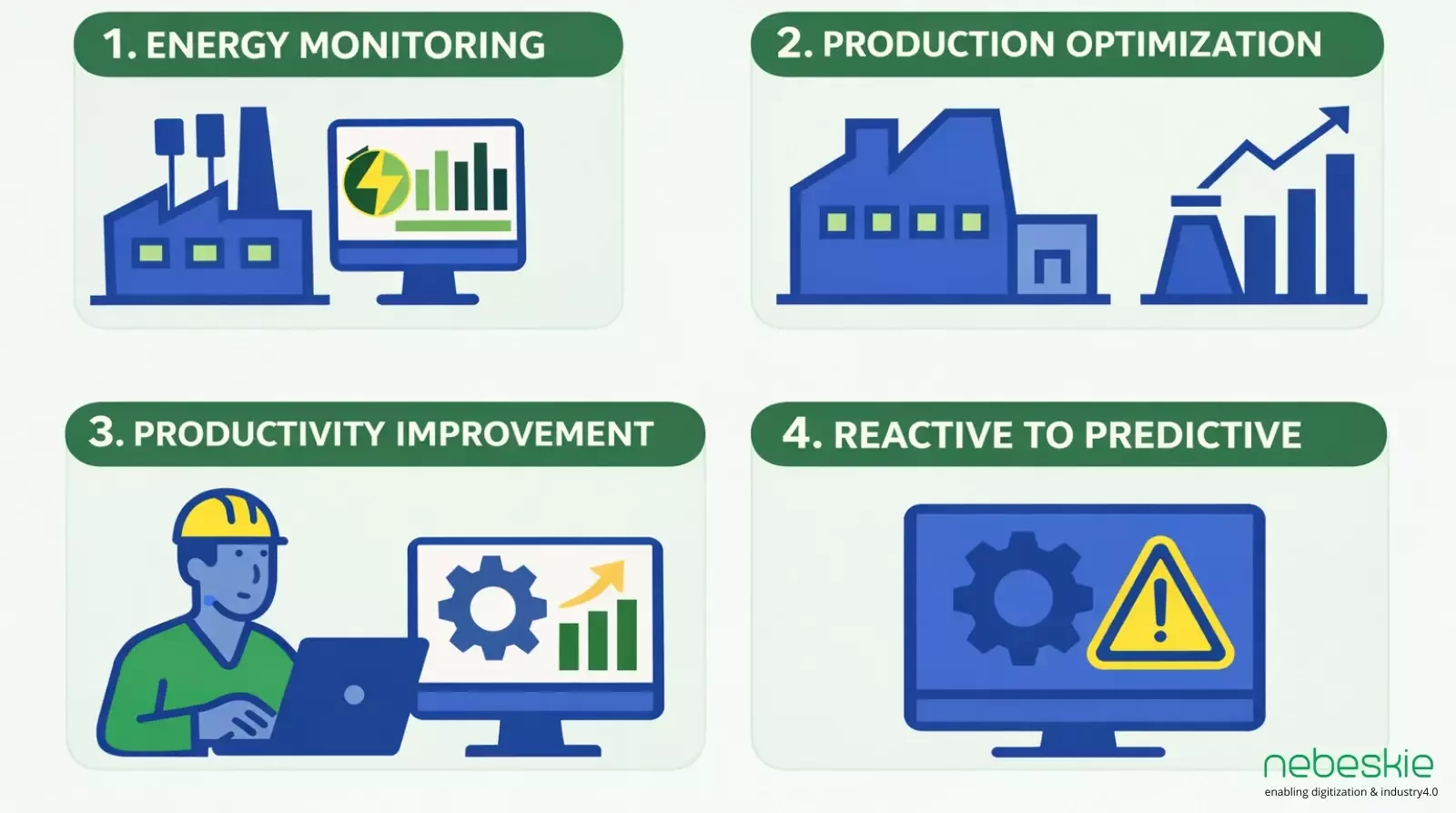
1. Energy Monitoring
Energy is one of the largest controllable operating expenses.
With IoT-enabled energy management, enterprises can:
- Track and reduce idle running of machines
- Monitor equipment-wise and plant-level energy consumption
- Identify abnormal power usage and inefficiencies
- Measure Specific Energy Consumption (SEC) per unit produced
This visibility enables both SMEs and large enterprises to control costs without compromising output.
2. Production Optimization
Unplanned interruptions, poor scheduling, and lack of real-time insights directly affect throughput.
Industry 4.0 enables:
- Reduction in production interruptions
- Better scheduling of manual and autonomous operations
- Real-time monitoring of production KPIs
- Early detection of process anomalies
For large enterprises, this improves line balancing and capacity utilization. For SMEs, it directly impacts delivery timelines and customer satisfaction.
3. Productivity Improvement
Machine downtime is expensive—especially when it is unexpected.
With IoT-based monitoring, enterprises can:
- Track machine health and operating conditions
- Reduce downtime through early fault detection
- Monitor productivity KPIs in real time
- Improve quality by detecting deviations early in the process
By identifying issues at intermediate stages, rejection of finished goods is significantly reduced—saving material, time, and cost.
Maintenance: From Reactive to Predictive
Most SMEs operate with reactive or calendar-based maintenance, while many large enterprises still struggle to fully implement predictive strategies.
IoT enables:
- Condition-Based Maintenance (CBM)
- Predictive maintenance using real-time and historical data
- Optimized maintenance schedules
- Reduced dependence on large in-house maintenance teams
For SMEs, IoT effectively acts as a “virtual maintenance engineer”, continuously monitoring assets and alerting teams before failures occur.
Energy and Asset Management: A Simple Framework
Collect
Data is collected from machines, meters, and processes at regular intervals.
Analyze
Time-based trends are created to understand relationships between production, energy consumption, and machine behavior.
Evaluate
Performance is compared against defined baselines to identify deviations and inefficiencies.
Improve
Root causes are identified, and corrective actions are implemented in collaboration with operations and maintenance teams.
This structured approach ensures measurable and repeatable improvements.
Benefits of Industry 4.0 Across Enterprise Sizes
For SMEs
- Faster ROI with minimal upfront investment
- Reduced downtime and maintenance costs
- Improved energy efficiency
- Better utilization of existing assets
- Ability to compete with larger players
For Large Enterprises
- Standardized visibility across multiple plants
- Scalable analytics and optimization
- Improved compliance and reporting
- Higher operational resilience
- Strong foundation for AI and advanced automation
Asset Management: Building Long-Term Value
Assets form the foundation of every manufacturing business. With IoT-enabled asset management, enterprises can:
- Increase asset life and performance
- Reduce unplanned downtime and risk
- Optimize maintenance and operational costs
- Improve overall agility and decision-making
- Lay the groundwork for predictive and prescriptive maintenance
Industry 4.0 as a Strategic Advantage
Industry 4.0 is no longer a future vision—it is a practical and necessary strategy for SMEs and large enterprises alike. The journey does not begin with massive automation projects but with monitoring, data visibility, and incremental improvements.
By saving operational expenditure through improved efficiency, enterprises can reinvest in:
- Skilled workforce retention
- Infrastructure upgrades
- Advanced digital solutions
In a competitive market, efficiency is growth—and Industry 4.0 is the key to unlocking it.