Walk through almost any industrial facility today and you'll still find them. Clipboards hanging near equipment. Operators filling out shift logs by hand. Maintenance teams recording inspections in notebooks. Quality checks captured on paper forms that will eventually be filed, scanned, or stored in a cabinet. Despite widespread digitization across manufacturing, utilities, energy, and process industries, some of the most critical operational data still originates on paper. For years, this was accepted as an unavoidable reality. Today, it is becoming a strategic liability.
As regulatory scrutiny increases, audit requirements become more demanding, and organizations seek greater operational visibility, digital checklists and logbooks are emerging from the realm of operational convenience into the category of business-critical infrastructure. The question is no longer whether organizations should digitize these processes. The question is whether they can afford not to.
Compliance Has Become a Data Problem
Most compliance failures do not occur because organizations lack procedures. They occur because organizations cannot consistently prove that procedures were followed. Auditors, regulators, customers, and certification bodies increasingly expect evidence that is:
- Accurate
- Traceable
- Tamper-resistant
- Time-stamped
- Easily retrievable
Paper-based systems struggle to meet these expectations. Forms go missing. Handwriting is misinterpreted. Entries are completed hours after activities occur. Data gets duplicated across spreadsheets. Version control becomes impossible. And when an audit arrives, teams spend weeks searching for records scattered across departments, facilities, and filing cabinets. In many organizations, compliance reporting has become an exercise in reconstruction rather than verification. The operational activity happened. The challenge is proving it.
The Hidden Cost of Paper Is Not Paper
Historically, audits were periodic events. Today, organizations increasingly operate in a state of continuous scrutiny. Whether driven by:
- ISO certifications
- ESG disclosures
- Environmental permits
- Energy management standards
- Food safety regulations
- Pharmaceutical requirements
- Customer quality programs
The expectation is the same: produce evidence, quickly and accurately. The organizations that perform best during audits are rarely the ones with the largest compliance teams. They are the ones with the most accessible and trustworthy data. Audit readiness is no longer a documentation exercise. It is a data architecture exercise.
From Checklists to Operational Intelligence
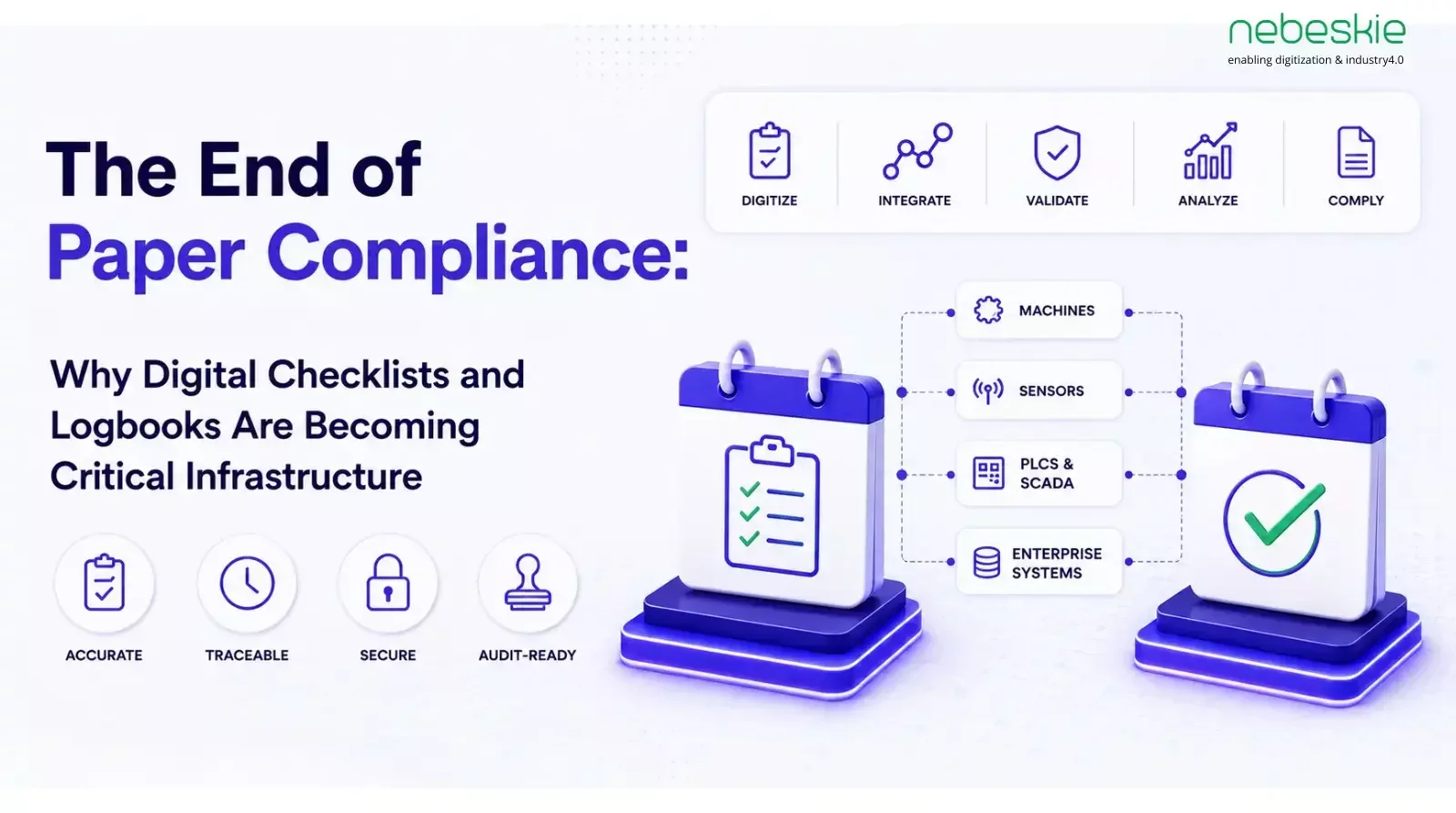
One of the biggest misconceptions surrounding digital checklists is that they merely replace paper forms with electronic versions. The leading organizations are doing something far more powerful. They are transforming checklists into operational intelligence platforms. Rather than relying solely on manual entries, modern digital logbooks integrate data directly from:
- Energy meters
- PLCs
- SCADA systems
- Building management systems
- IoT sensors
- Production equipment
- Utility monitoring systems
This creates an important shift. Instead of operators manually recording equipment parameters, many values can be automatically captured in real time. The operator's role evolves from data collection to data validation and exception management. The result is dramatically higher data accuracy and significantly lower reporting effort.
The Rise of the Connected Digital Logbook
This is where a purpose-built Digital Checklist and Logbook application changes the equation. Rather than functioning as a standalone form-filling tool, the platform becomes a centralized operational data repository that combines:
Automated Data Capture
Machine parameters, energy readings, process values, and operational KPIs are collected automatically from connected systems and equipment.
Structured Manual Inputs
Operators continue capturing observations, inspections, safety checks, maintenance activities, and shift information through digital forms and mobile devices.
Real-Time Validation
Entries can be validated instantly against predefined thresholds, ensuring anomalies are flagged before they become compliance issues.
Centralized Record Management
All records are stored in a single searchable repository, eliminating fragmented spreadsheets, paper archives, and disconnected databases.
Audit Trails
Every action, modification, approval, and submission is timestamped and traceable, creating a defensible record for auditors and regulators. What emerges is not simply a paperless process. It is a single source of truth for operational compliance.
Eliminating Misreporting at the Source
Most organizations focus on detecting reporting errors. The better approach is preventing them altogether. Digital checklists and logbooks address one of the largest causes of compliance risk: manual data transfer. When operational data moves across multiple systems, spreadsheets, and paper forms, errors become inevitable. By integrating directly with machines, sensors, and enterprise systems, digital platforms reduce the number of times data must be manually handled.
This creates several advantages:
- Improved data accuracy
- Reduced reporting effort
- Faster compliance reporting
- Better operational visibility
- Lower audit risk
- Higher stakeholder confidence
Instead of debating which version of a spreadsheet is correct, organizations can focus on improving performance.
The Strategic Shift: From Record-Keeping to Decision-Making
Perhaps the most important benefit of digital logbooks is often overlooked. They transform historical records into actionable intelligence. When checklist data, equipment data, maintenance records, production information, and energy consumption metrics exist within the same ecosystem, organizations gain the ability to identify patterns that paper systems can never reveal. They can answer questions such as:
- Which assets generate the most compliance deviations?
- Which processes require the highest operator intervention?
- Where are recurring operational risks emerging?
- Which facilities consistently outperform others?
- How are operational events impacting energy consumption and production performance?
The value extends far beyond audit readiness. It becomes a foundation for operational excellence.
The Leadership Imperative
Many organizations still view digital checklists and logbooks as a process improvement initiative. Increasingly, they should be viewed as a governance and compliance initiative. The pressure for accurate reporting—whether related to quality, safety, sustainability, energy, or regulatory requirements—continues to increase. At the same time, stakeholders are demanding greater transparency and faster access to verifiable records. Paper systems were designed for an era when audits happened once a year. Modern organizations operate in an environment where compliance is expected every day.
The Bottom Line
Digital checklists and logbooks are no longer simply replacements for pen-and-paper records. They are becoming the operational backbone that supports audit readiness, compliance reporting, data integrity, and organizational transparency. Organizations that continue relying on fragmented manual processes will find themselves spending increasing amounts of time validating, reconciling, and defending their data.
Those that implement a connected Digital Checklist and Logbook platform—combining real-time machine data, structured operator inputs, automated workflows, and centralized record management—will gain something far more valuable than paperless operations. They will gain confidence in their data. And in a world where compliance, sustainability, quality, and operational performance are all ultimately judged by the quality of that data, confidence may become one of the most important competitive advantages of all.