
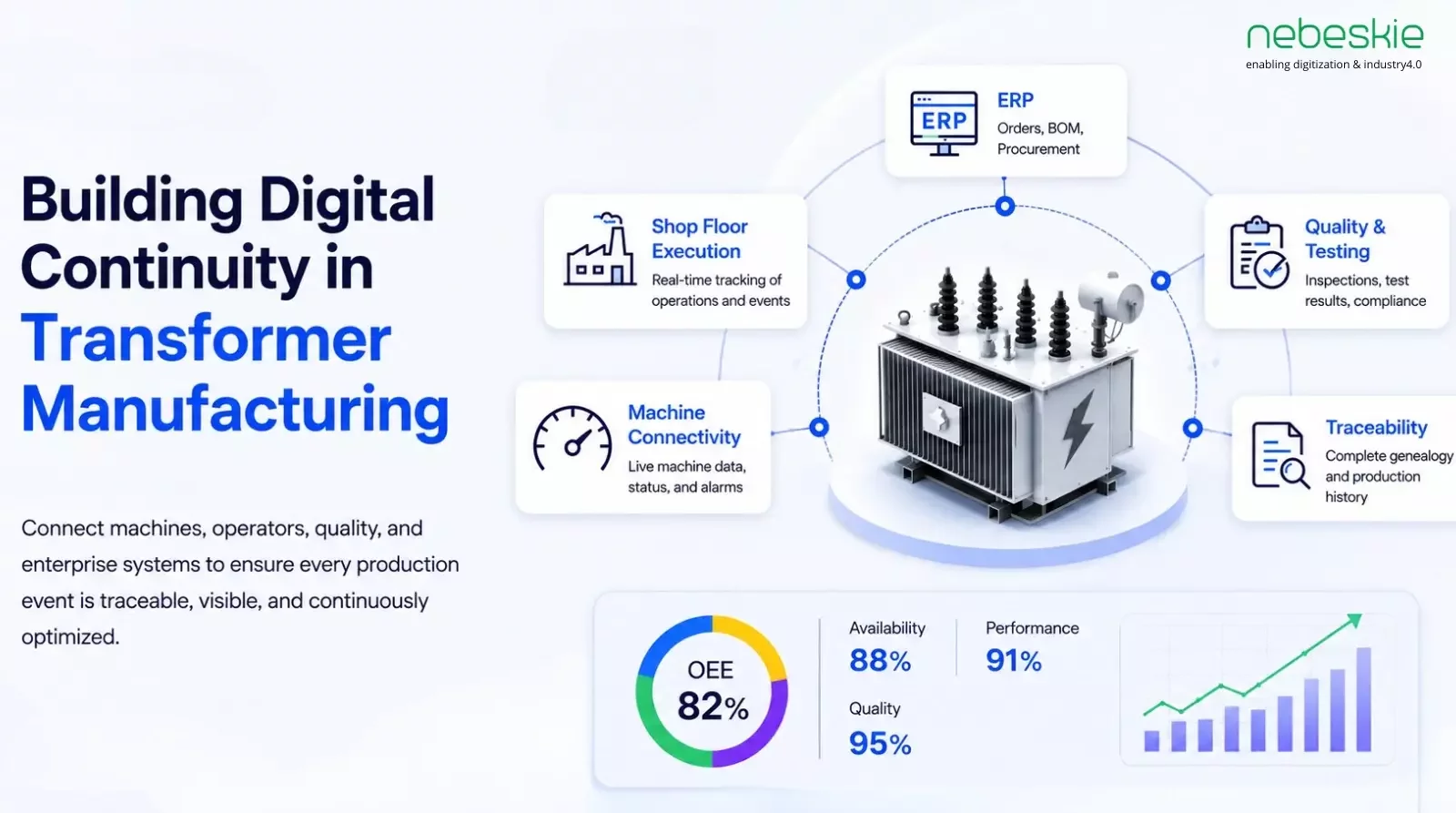
Most manufacturers already collect data. The real problem is that the data rarely moves with the product.
In transformer and reactor manufacturing, this disconnect creates operational blind spots that are difficult to ignore. Engineering teams work in one system, production teams rely on manual tracking, and quality records often live in spreadsheets or isolated databases. By the time a problem surfaces, tracing it back to the source becomes a slow and expensive exercise.
Industry 4.0 is often framed as a machine connectivity challenge. In reality, for engineer-to-order manufacturing environments, the bigger challenge is continuity — ensuring that every material movement, production event, inspection, and test result stays connected across the lifecycle of a product.
That shift changes how manufacturers should think about digital transformation.
The Real Bottleneck Isn’t Data Collection
Transformer and reactor manufacturing operates differently from high-volume repetitive production. Workflows are highly customized, production cycles are long, and every unit carries unique engineering, testing, and compliance requirements.
Many facilities still rely on systems that were never designed to communicate with each other:
ERP systems manage orders and procurement
Machine controllers generate production data
Operators manually update production status
Quality records are stored separately from manufacturing events
Maintenance teams track downtime independently
The result is fragmented operational visibility.
A plant may know which work order is active, but not the real-time production status of a winding operation. Machine utilization may be tracked, but disconnected from production schedules. Test reports may exist, but without a direct digital link to the exact production history of the unit.
This creates several persistent problems:
Limited Traceability
When genealogy tracking is incomplete, manufacturers struggle to connect raw materials, process steps, inspections, and final test results into a unified production history.
For industries handling high-value engineered products, this becomes a serious operational risk.
Delayed Decision-Making
Production teams often react to issues after the fact because data arrives too late or lacks context. Downtime, process deviations, and bottlenecks become visible only during shift reviews or management meetings.
Inconsistent OEE Visibility
Many manufacturers calculate Overall Equipment Effectiveness (OEE) manually or based on incomplete machine signals. Without accurate runtime, feed, load, and downtime classification data, OEE becomes a reporting metric instead of an operational tool.
IT and OT Remain Isolated
Even in digitally mature plants, enterprise systems and shop floor systems frequently evolve separately. The lack of a unified data layer makes scaling automation initiatives far more difficult than expected
The Industry Is Moving Toward Contextualized Manufacturing Data
The next phase of Industry 4.0 is not about collecting more machine signals. It is about creating operational context around manufacturing events.
That means every production activity should answer questions like:
Which work order triggered this event?
Which operator and machine were involved?
Which component batch was used?
Which inspection or test result belongs to this stage?
What production conditions existed at that moment?
This is where Manufacturing Execution Systems (MES) and connected shop floor platforms become critical.
A modern MES is no longer just a production tracking tool. It acts as the operational bridge between ERP systems, machines, operators, and quality workflows.
In transformer manufacturing, this creates digital continuity across the entire production lifecycle.
For example:
Core assembly events can be tied directly to work orders
Winding machine performance can be monitored in real time
Test data can be attached to specific serial numbers
Operator actions and process deviations become traceable
Production visibility becomes available across shifts and departments
Instead of disconnected records, manufacturers gain a unified operational history.
Real-World Visibility Starts at the Machine Layer
One of the biggest misconceptions in Industry 4.0 projects is that machine connectivity alone creates visibility.
In practice, raw machine data is rarely useful without interpretation.
Consider a CNC machining environment supporting transformer component manufacturing. A machine may expose spindle load, feed rate, runtime, and alarm data through PLC signals. But unless those signals are mapped correctly and connected to production context, manufacturers still cannot answer critical operational questions.
For example:
Was the machine actually producing or idle?
Which work order was active during runtime?
Did feed overrides affect cycle performance?
Which shift experienced recurring downtime?
Was spindle load linked to process anomalies?
In many plants, obtaining this level of visibility requires detailed mapping between PLC addresses, machine states, and production workflows.
Once connected properly, however, the impact is significant.
Machine-level visibility enables manufacturers to:
Measure real production utilization
Detect downtime patterns earlier
Improve shift-level accountability
Track OEE with higher accuracy
Build a reliable foundation for predictive analytics
The difference is not just automation. It is operational clarity.
Bridging the Gap Between ERP and the Shop Floor
ERP systems remain essential for planning and business operations. But ERP alone cannot represent the dynamic reality of the factory floor.
Production environments change minute by minute:
Machines stop unexpectedly
Operators adjust workflows
Material availability shifts
Quality checks interrupt schedules
Rework loops affect delivery timelines
Without a real-time execution layer, ERP systems become disconnected from actual production conditions.
This is why many manufacturers are now investing in MES-driven architectures that unify:
Production execution
Machine connectivity
Traceability
Quality workflows
Real-time monitoring
Operational analytics
For transformer and reactor manufacturers, the value is especially high because production complexity is inherently difficult to standardize.
The ability to digitally connect engineering, operations, quality, and machine data creates a far more resilient manufacturing environment.
Where Platforms Like Enture Fit In
Platforms such as Enture help manufacturers build this connected operational layer without relying on fragmented custom integrations.
By connecting shop floor events directly to ERP-driven workflows, manufacturers can create a unified manufacturing data backbone across machines, operators, and production systems.
Capabilities such as:
Real-time machine monitoring
MES-driven production tracking
Native industrial protocol connectivity
OEE visualization
Traceability workflows
Quality and inspection integration
allow manufacturers to move beyond isolated automation projects toward scalable digital operations.
In environments where legacy equipment, custom processes, and engineer-to-order production are common, this flexibility becomes essential.
The goal is not simply to digitize the factory. It is to make manufacturing operations measurable, traceable, and continuously improvable.
The Manufacturers That Build Context Will Move Faster
The competitive advantage in modern manufacturing will not come from who collects the most data.
It will come from who can operationalize that data fastest.
Transformer and reactor manufacturers are entering a phase where digital continuity matters as much as production capacity. The ability to connect engineering intent, machine execution, operator activity, and quality validation into a unified workflow will define how efficiently plants scale in the coming years.
Manufacturers that build this operational visibility now will be better positioned to improve traceability, reduce production uncertainty, and respond faster to changing customer demands.
The gap between the shop floor and business systems is shrinking. The next step is turning that connection into actionable manufacturing intelligence.