
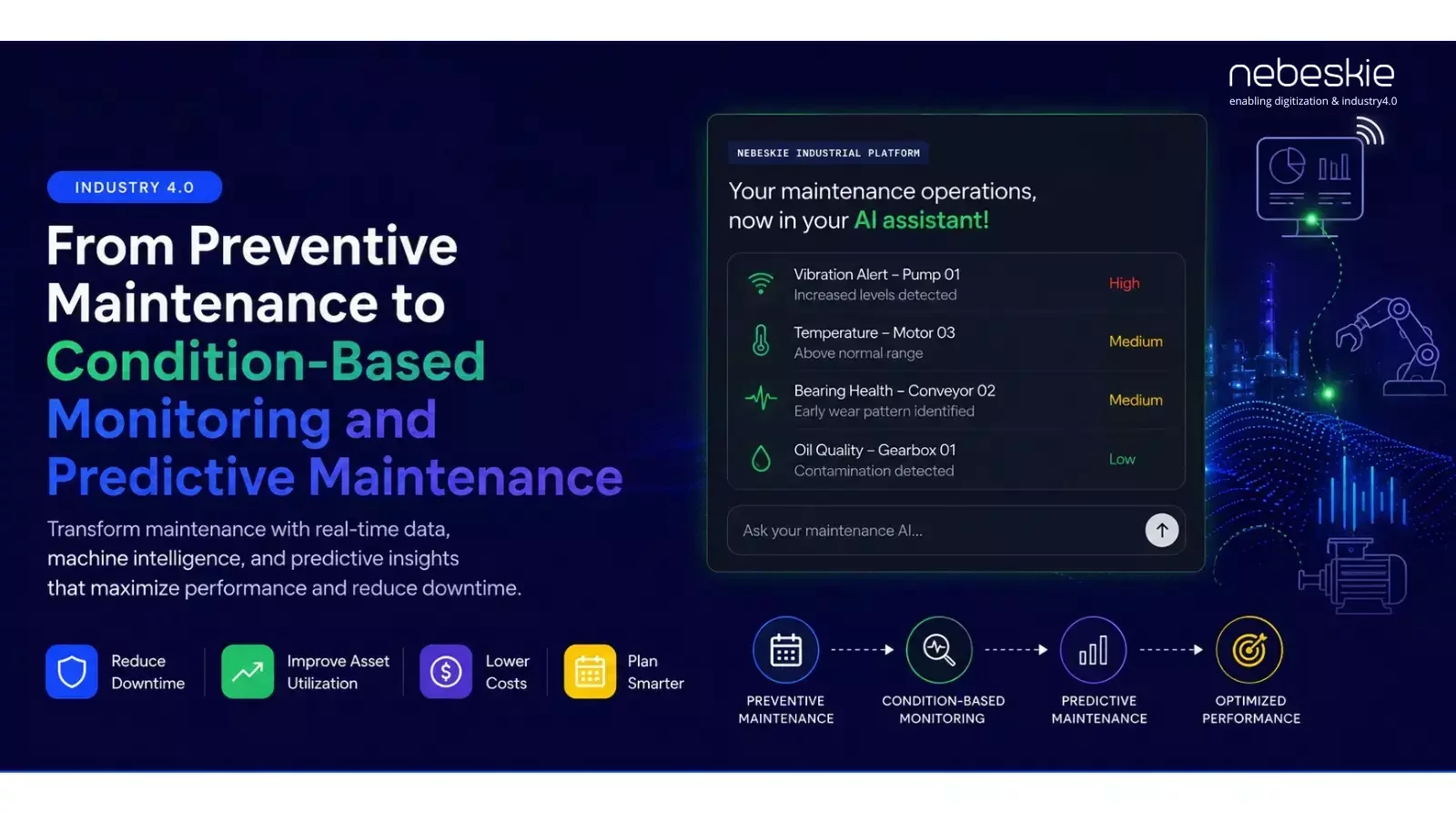
While preventive maintenance helped reduce unexpected breakdowns, it was never designed for today's highly connected and data-driven industrial environments.
As Industry 4.0 continues to reshape manufacturing, organizations are shifting toward maintenance strategies that leverage real-time operational data, machine intelligence, and predictive analytics.
The goal is no longer simply maintaining equipment.
The goal is maximizing asset performance, reducing downtime, and making maintenance decisions based on actual equipment conditions.
This shift is changing how manufacturers approach reliability, operational efficiency, and digital transformation.
The Limitations of Traditional Preventive Maintenance
Although this approach improves equipment reliability compared to reactive maintenance, it presents several challenges.
Maintenance may be performed too early, resulting in unnecessary costs.
Critical components may fail before the scheduled service interval.
Resources are often allocated based on assumptions rather than actual machine conditions.
Many manufacturers still rely on maintenance plans that provide limited visibility into how equipment is performing in real-world operating conditions.
As production demands increase, these limitations become more significant.
The Rise of Condition-Based Monitoring
Industry 4.0 technologies have introduced a new possibility: monitoring equipment continuously and making maintenance decisions based on actual asset health.
Condition-Based Monitoring (CBM) uses real-time data collected from machines, sensors, and industrial control systems to evaluate equipment performance.
Instead of relying solely on maintenance schedules, organizations can monitor key indicators such as:
- Vibration levels
- Temperature variations
- Motor current consumption
- Pressure and flow conditions
- Lubrication quality
- Machine operating status
When abnormal conditions are detected, maintenance teams can investigate issues before they develop into failures.
This approach helps organizations move from time-based maintenance to condition-driven maintenance
Why Data Context Matters
Collecting machine data alone does not create actionable insights.
A vibration alarm may indicate a problem, but understanding its operational context is what enables effective decision-making.
Manufacturers need answers to questions such as:
- Which asset generated the alert?
- Under what operating conditions did it occur?
- Was the machine running at full load?
- Has the condition appeared previously?
- How is the issue affecting production performance?
Without context, maintenance teams receive data.
With context, they receive intelligence.
This is one of the key principles behind Industry 4.0 maintenance strategies.
From Monitoring to Predictive Maintenance
Condition-Based Monitoring provides visibility into current asset conditions.
Predictive Maintenance takes the next step by forecasting future failures before they occur.
Using historical machine data, operational patterns, and advanced analytics, predictive maintenance solutions can identify trends that indicate potential equipment degradation.
For example:
- Bearing wear can be detected before vibration levels become critical.
- Motor performance degradation can be identified through current analysis.
- Thermal patterns may reveal developing electrical faults.
- Production anomalies can highlight early signs of equipment issues.
Rather than reacting to alarms, maintenance teams can proactively schedule interventions at the optimal time.
The result is improved reliability and reduced unplanned downtime.
The Business Impact of Predictive Maintenance
Organizations implementing predictive maintenance often achieve benefits that extend beyond maintenance departments.
Reduced Unplanned Downtime
Unexpected equipment failures are among the most expensive disruptions in manufacturing.
Predictive maintenance enables early detection of potential issues, reducing production interruptions and emergency repairs.
Improved Asset Utilization
Equipment remains available for longer periods because maintenance activities are performed only when necessary.
This improves overall production efficiency and asset performance.
Lower Maintenance Costs
By avoiding unnecessary maintenance activities and preventing major failures, organizations can optimize maintenance spending and resource allocation.
Extended Equipment Life
Continuous monitoring helps identify operating conditions that contribute to premature wear, allowing corrective actions before long-term damage occurs.
Better Operational Planning
Maintenance activities become predictable and can be aligned with production schedules, minimizing operational disruptions.
Industry 4.0 Creates the Foundation
The transition from preventive maintenance to predictive maintenance depends on a connected digital infrastructure.
Manufacturers need the ability to collect, contextualize, and analyze data from multiple sources, including:
- PLCs and machine controllers
- Industrial sensors
- SCADA systems
- MES platforms
- Enterprise systems
- Edge computing environments
A connected data architecture ensures that maintenance insights are based on accurate and real-time operational information.
This is why digitalization initiatives and maintenance transformation often progress together.
Where Platforms Like Enture Fit In
Modern industrial platforms such as Enture help manufacturers build the connected data foundation required for Condition-Based Monitoring and Predictive Maintenance.
By integrating machine connectivity, industrial protocols, edge computing, and operational data management, organizations can create a unified view of asset performance.
Capabilities such as:
- Real-time machine monitoring
- Industrial protocol connectivity
- Edge-based data processing
- Asset performance visualization
- Historical data analysis
- Predictive analytics integration
allow manufacturers to move beyond traditional maintenance practices and adopt more intelligent maintenance strategies.
The objective is not simply to collect machine data.
It is to transform operational data into actionable maintenance intelligence.
The Future of Maintenance Is Predictive
Industry 4.0 is fundamentally changing how manufacturers manage their assets.
The organizations achieving the greatest operational improvements are not necessarily those collecting the most data.
They are the ones using data to make faster and more informed decisions.
Preventive maintenance remains an important foundation, but the future belongs to maintenance strategies that understand asset conditions in real time and anticipate failures before they happen.
As digitalization continues to accelerate, Condition-Based Monitoring and Predictive Maintenance will become essential components of smart manufacturing.
Manufacturers that invest in these capabilities today will be better positioned to improve reliability, reduce downtime, and create more resilient operations for the future.