
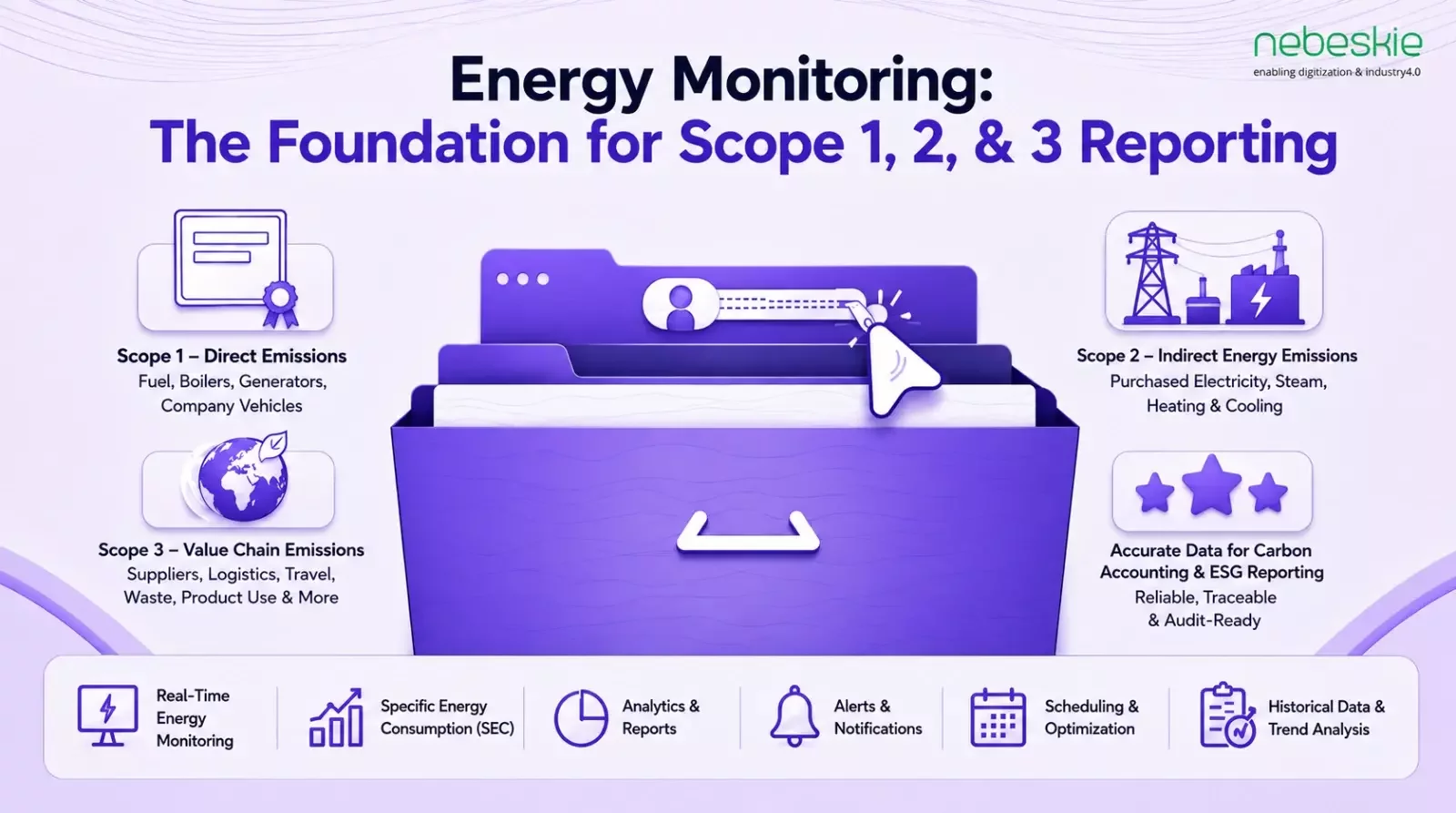
Every credible carbon strategy rests on a quiet, unglamorous layer of infrastructure: the meters, sensors, and data pipelines that tell an organization how much energy it actually consumes, when, and from where. Carbon accounting frameworks, science-based targets, and supplier scorecards all get the attention, but none of them mean anything without energy monitoring underneath them. Get the monitoring wrong, and every number built on top of it — Scope 1, Scope 2, Scope 3 — inherits that error.
This is the part of decarbonization that doesn't make headlines. It's also the part that determines whether a company's emissions disclosures hold up under scrutiny or collapse the moment an auditor, regulator, or activist investor starts asking where the numbers came from.
Why Monitoring, Not Reporting, Is the Real Starting Point
Most organizations approach emissions work backwards. They start with a reporting framework — the GHG Protocol, CDP, CSRD, SEC climate rules — and try to populate it with whatever data is on hand: utility bills, fuel receipts, supplier estimates, industry-average emission factors. The framework comes first; the data is reverse-engineered to fit it.
A more durable approach treats energy monitoring as the primary system and reporting as a downstream output. If an organization has granular, continuous visibility into electricity, fuel, steam, and refrigerant use across its facilities, fleets, and equipment, Scope 1 and Scope 2 reporting becomes an exercise in aggregation rather than estimation. Scope 3, while harder, also improves dramatically once an organization understands its own energy profile well enough to ask better questions of its suppliers and customers.
Treating monitoring as the foundation also changes the incentive structure internally. Energy data stops being something finance or sustainability teams scramble to assemble once a year for a report, and becomes an operational asset that facilities, procurement, and engineering teams use continuously to manage cost, reliability, and risk. Emissions accuracy becomes a byproduct of good operational management rather than a compliance afterthought.
The Data Accuracy Problem Is Different at Each Scope
It's tempting to treat "data quality" as a single problem to be solved once. In practice, the accuracy challenge looks completely different depending on which scope is in question.
Scope 1 — direct emissions sound like they should be the easiest to measure, since the organization owns or controls the source. In reality, Scope 1 data is fragmented across combustion equipment, company vehicles, on-site generators, and fugitive emissions from refrigerants and industrial gases. Many sites still rely on annual fuel purchase volumes rather than metered consumption, which obscures operational variability and makes it nearly impossible to detect leaks, inefficiencies, or anomalies in near real time. Fugitive emissions in particular are notoriously underreported because they require specialized leak-detection equipment that most facilities simply don't have installed.
Scope 2 — purchased energylooks straightforward on paper: take electricity consumption and multiply by a grid emission factor. The accuracy problem here is temporal and locational. Annual or monthly utility data, combined with an annual average grid factor, can be wildly misleading in markets with significant renewable penetration, where the carbon intensity of the grid can swing several-fold within a single day. The shift toward hourly, location-based accounting (sometimes called 24/7 carbon-free energy matching) is exposing how crude most current Scope 2 reporting really is. Organizations that only have monthly billing data are, in effect, reporting an average that no single hour of their actual operation ever experienced.
Scope 3 — value chain emissions is where the data accuracy problem becomes existential. For most companies, Scope 3 represents the overwhelming majority of total emissions, yet it depends on data the organization doesn't generate and often can't directly verify: supplier-reported energy use, secondary emission factors, spend-based estimates, and assumptions about product lifecycles. The fundamental challenge is that Scope 3 accuracy is capped by the weakest link in a long chain of partners, many of whom have no monitoring infrastructure of their own, no incentive to share granular data, and no standardized way to report it even if they wanted to.
Why This Matters Beyond Compliance
The temptation is to treat these accuracy gaps as a reporting nuisance — close enough for a sustainability report, fix it later. That framing underestimates what's at stake.
Inaccurate energy data leads organizations to misallocate capital toward decarbonization initiatives that look good on paper but don't move the needle operationally. It exposes companies to reputational and legal risk as disclosure regulations tighten and the bar for "reasonable assurance" rises. And it quietly erodes the credibility of climate commitments across the board: every greenwashing controversy that traces back to faulty measurement makes stakeholders more skeptical of the next company's numbers, accurate or not. There's also a strategic cost that's easy to overlook. Organizations with poor energy visibility can't actually manage what they can't see. They miss demand-response opportunities, overpay for capacity they don't need, and fail to catch equipment degradation until it shows up as a maintenance failure rather than a slow drift in a monitoring dashboard. The same granular data that makes Scope 1 and 2 reporting defensible also makes operations more efficient — the two goals are far more aligned than most organizations realize.
What Better Monitoring Actually Requires
Closing these accuracy gaps isn't primarily a software problem, though software plays a role. It requires: Sub-metering at a level of granularity that matches how decisions actually get made — by building, by process line, by piece of equipment — rather than a single utility meter aggregating an entire site. Continuous, automated data collection that replaces manual meter reads and estimated bills with telemetry that can be reconciled and audited. Standardized emission factors that are kept current as grids decarbonize and regulations evolve, rather than static figures reused year over year. And, for Scope 3 in particular, a deliberate strategy for engaging suppliers — moving them from spend-based estimates toward primary, metered data over time, even if that transition takes years rather than quarters.
None of this is a one-time project. Energy monitoring infrastructure needs the same ongoing investment and maintenance as any other operational system, because meters drift, equipment changes, facilities expand, and grids evolve. Organizations that treat monitoring as a one-off implementation tend to find their data quality silently degrading within a year or two.
The Bottom Line
Scope 1, 2, and 3 reporting will only ever be as good as the energy monitoring infrastructure beneath it. Organizations that invest in granular, continuous, verifiable measurement aren't just preparing for the next disclosure deadline — they're building the operational foundation that makes every subsequent decarbonization decision more defensible and more effective. The companies that get this right won't just report better numbers. They'll have the visibility to actually act on them