
The “Invisible” Problem Holding Back Smart Factories
Ask any plant leader about their Industry 4.0 roadmap, and you’ll hear about AI, predictive maintenance, or advanced analytics.
But rarely will you hear about OT-IT integration.
And yet, here’s the uncomfortable truth:
OT-IT integration is the most critical—and most neglected—layer in any Smart Factory journey.
It’s not glamorous. It doesn’t appear in dashboards. It’s rarely owned by a single team.
But if you get it wrong, everything built on top of it—MES, analytics, AI—becomes fragile, expensive, or simply unusable.
Most manufacturers don’t fail in their digital transformation because of lack of tools.
They fail because the foundation is broken before the first application even goes live.
The Real Problem: Fragmented Data, Fragmented Ownership
Walk into a typical factory floor, and you’ll find a complex ecosystem:
Legacy CNC machines with proprietary interfaces
PLC-driven processes with inconsistent data models
Modern equipment supporting OPC-UA alongside older protocols
Paper-based or manual data capture still in critical workflows
When manufacturers attempt to digitize:
Data is hard to extract from legacy systems
Signals are inconsistent across machines
Context (work orders, batch info, genealogy) is missing
Integration is treated as a one-off effort per application
The result?
Projects never start
The perceived complexity of industrial connectivity freezes decision-making.
Substandard integration layers emerge
Teams build quick “dashboard connectors” instead of a scalable data infrastructure.
Over-reliance on application vendors
Manufacturers assume that if they buy an MES or analytics tool, integration will come bundled—and optimized.
In reality, this approach leads to tightly coupled systems where:
Data pipelines are fragile
Scaling new use cases becomes exponentially harder
Vendor lock-in limits flexibility
Most critically, the organization never builds a reusable data backbone.
And without that, the Smart Factory remains an aspiration—not an operational reality.
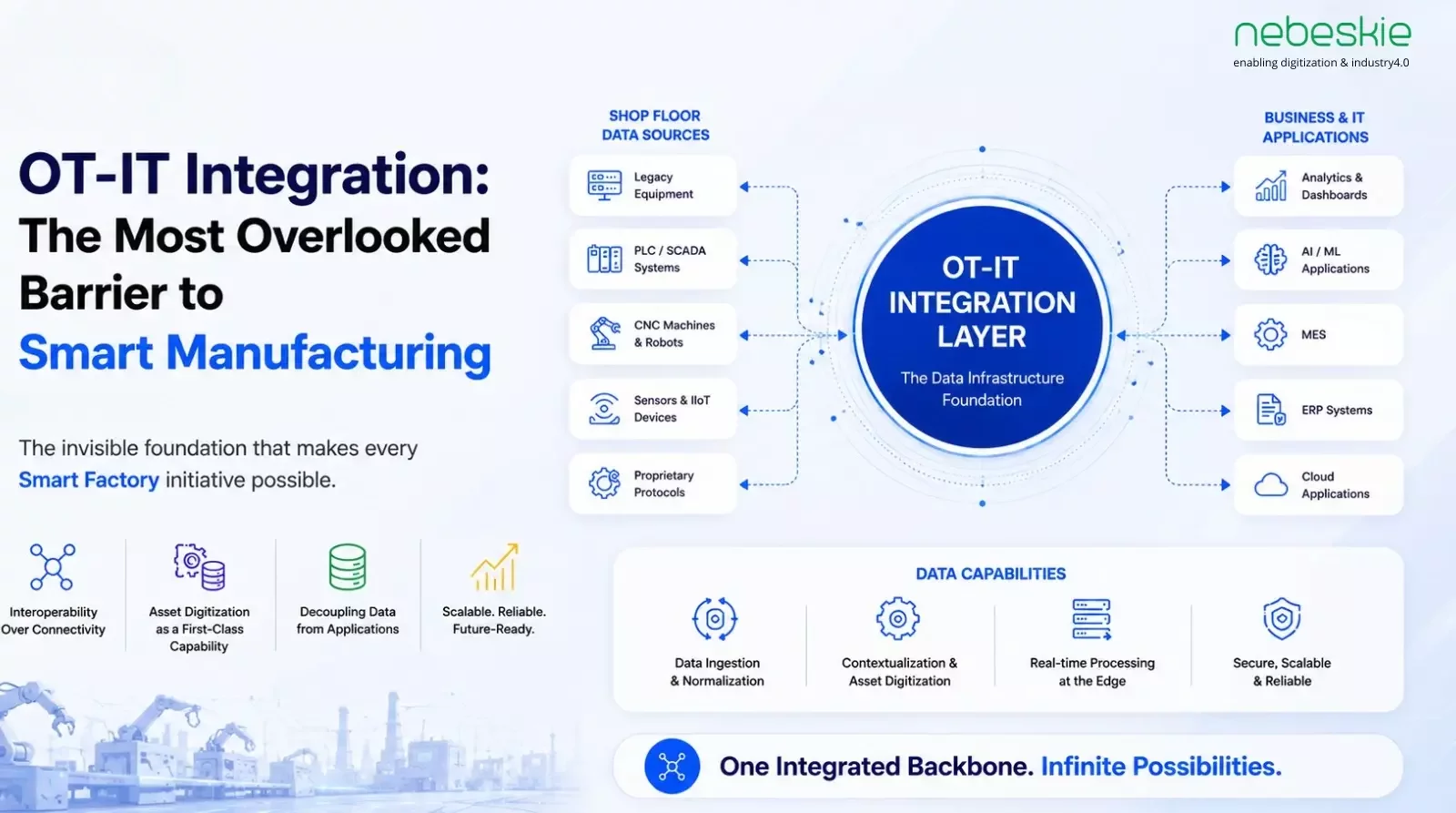
A New Mental Model: OT-IT Integration as a Data Infrastructure Layer
The industry needs to rethink OT-IT integration—not as a project, but as infrastructure.
Instead of asking:
“How do we connect this machine to this application?”
The better question is:
“How do we build a standardized, scalable data highway from shop floor to enterprise systems?”
This shift introduces three key principles:
1. Interoperability Over Connectivity
Connecting machines is easy.
Making their data usable across systems is hard.
A robust OT-IT layer must:
Normalize data from heterogeneous protocols (OPC-UA, Modbus, proprietary interfaces)
Standardize machine tags into unified data models
Maintain semantic consistency across assets
Without interoperability, every new application becomes a custom integration project.
2. Asset Digitization as a First-Class Capability
Raw signals are not enough.
To enable meaningful downstream use cases, data must be structured around:
Machines and equipment hierarchies
Work orders and production context
Process states and events
Quality and test data
This is what transforms “data collection” into asset digitization—a prerequisite for traceability, optimization, and AI.
3. Decoupling Data from Applications
In most factories today, data pipelines are tied directly to applications:
MES pulls directly from PLCs
Dashboards rely on custom scripts
Analytics tools ingest inconsistent data formats
This creates brittle architectures.
A modern approach introduces a middleware layer:
A centralized, edge-enabled data platform
Real-time ingestion and processing
Contextualization before data reaches applications
This decoupling ensures:
Applications become plug-and-play
New use cases can be deployed faster
Data remains consistent across systems
In essence, you build once—and scale infinitely.
What This Looks Like in Practice
Consider a large dairy manufacturer starting its digital journey.
Initially, their approach was typical:
Deploy individual solutions for monitoring
Integrate machines directly with dashboards
Rely on vendors for data extraction
The result? Fragmented visibility, inconsistent data, and no foundation for advanced use cases.
The turning point came when they adopted a dedicated OT-IT middleware layer:
Machine data was standardized across plants
Asset hierarchies were digitized
Real-time data pipelines were established independent of applications
Only after this shift did higher-value initiatives become viable:
AI models could be trained on consistent datasets
Cross-line performance benchmarking became possible
Operational decisions moved from reactive to predictive
In short, they didn’t become AI-ready by adding AI tools.
They became AI-ready by fixing their data foundation.
Bridging the Gap: The Role of Industrial Data Platforms
This is where modern industrial platforms play a critical role.
A purpose-built OT connectivity and data infrastructure layer—such as an edge-enabled industrial platform—acts as:
A universal connector across legacy and modern equipment
A data normalizer ensuring interoperability
A context engine for asset digitization
A real-time data backbone for all applications
Technologies like industrial connectors and edge operating systems enable:
Protocol-level integration without custom coding
Distributed processing close to the machine
Scalable architectures aligned with ISA-95 levels
Rather than solving integration repeatedly for each use case, manufacturers get a repeatable, reusable foundation.
This is the difference between:
Building isolated digital tools
And building a true Smart Factory ecosystem
The Bottom Line: Start with the Foundation, Not the Applications
The gap between data and decision-making is shrinking—but only for those who build the right foundation.
OT-IT integration is no longer a backend concern.
It is the strategic enabler of interoperability, asset digitization, and scalable Smart Factory initiatives.
Manufacturers who continue to treat integration as an afterthought will face:
Rising integration costs
Slower innovation cycles
Limited ability to adopt AI and advanced analytics
Those who invest in a proper data infrastructure layer will:
Accelerate every digital initiative
Reduce dependency on vendors
Create a future-proof manufacturing architecture
Explore What a True OT-IT Backbone Looks Like
If you’re rethinking your Smart Factory strategy, the question isn’t which application to start with.
It’s whether your current architecture can support the next five.
A modern, edge-enabled OT-IT integration layer can fundamentally change that trajectory—turning fragmented data into a scalable, interoperable asset.
The manufacturers who get this right today will define the benchmarks of tomorrow.