
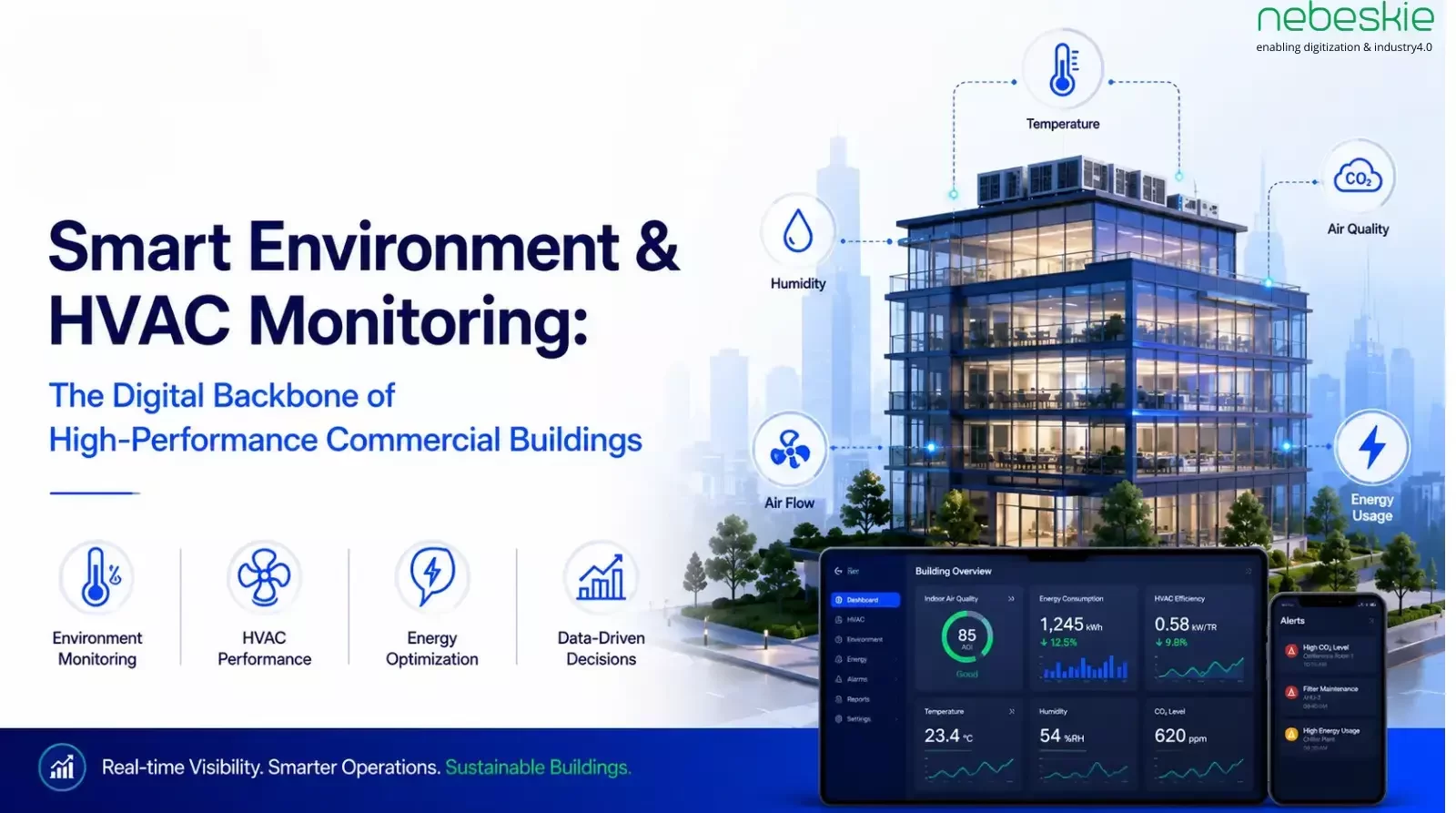
The conversation around smart buildings has evolved significantly over the past decade. While energy efficiency remains a priority, leading organizations are increasingly recognizing that operational excellence begins with visibility. Similar to how energy monitoring forms the foundation of effective carbon reporting, centralized environmental and HVAC monitoring has become the foundation of intelligent building operations. Buildings that lack real-time visibility into environmental conditions, equipment performance, and energy consumption are often forced to make operational decisions based on assumptions, periodic inspections, and fragmented data sources rather than measurable insights.
As commercial real estate portfolios become more complex and sustainability targets become more ambitious, facility leaders are turning to Industry 4.0 technologies to transform buildings from reactive environments into continuously optimized operational assets.
The Hidden Cost of Limited Operational Visibility
Most commercial buildings today generate enormous volumes of operational data, but very little of that information is converted into actionable intelligence. Environmental sensors, Building Management Systems (BMS), HVAC controllers, utility meters, and maintenance platforms frequently operate in silos. As a result, facility teams often have no single source of truth to understand how building performance changes throughout the day.
Consider a large corporate office where occupant complaints about temperature fluctuations continue despite regular HVAC maintenance. Upon deeper investigation, the root cause may not be the HVAC equipment itself but occupancy-driven heat loads, improperly balanced air handling units, or excessive fresh air intake during peak hours. Without centralized monitoring, these relationships remain invisible.
The operational impact extends beyond occupant comfort. Inefficient HVAC operation often leads to higher energy consumption, accelerated equipment degradation, increased maintenance costs, and reduced asset life. By the time these issues become apparent, organizations have already incurred significant avoidable costs.
Why HVAC Systems Require Continuous Intelligence
HVAC infrastructure represents the largest operational energy consumer in most commercial facilities, accounting for a substantial portion of overall building energy use. Yet many organizations continue to manage HVAC assets through scheduled maintenance intervals rather than performance-based monitoring.
Industry leaders such as Trane, Carrier, Daikin, Johnson Controls, Siemens, Honeywell, Schneider Electric, Mitsubishi Electric, and LG are increasingly integrating digital capabilities into their HVAC ecosystems because equipment efficiency alone is no longer sufficient. Continuous performance visibility has become equally important.
For example, a centrifugal chiller designed to operate at 0.55 kW/TR may gradually drift to 0.75 kW/TR due to condenser fouling, poor water treatment, or control sequence issues. The chiller continues operating, and occupants experience no immediate disruption, but energy costs increase substantially over time. Traditional maintenance approaches may not detect this degradation until the next inspection cycle. A centralized monitoring platform, however, can identify efficiency deviations in real time and alert operations teams before costs escalate.
Similarly, air handling units often experience hidden performance issues such as clogged filters, damper malfunctions, sensor drift, or excessive fan runtimes. Continuous monitoring enables engineers to correlate airflow performance, indoor environmental conditions, and energy consumption to identify the exact source of inefficiency.
Smart Environment Monitoring: Moving Beyond Temperature Control
Historically, building performance was measured primarily through temperature management. Today, occupant wellbeing and regulatory expectations demand a far more comprehensive approach to environmental monitoring.
Modern smart buildings continuously monitor parameters such as temperature, humidity, carbon dioxide concentration, particulate matter (PM2.5 and PM10), volatile organic compounds (VOCs), differential pressure, noise levels, and occupancy patterns. These variables collectively define Indoor Environmental Quality (IEQ), which has a direct impact
on occupant health, productivity, and comfort.
Consider a commercial office where indoor CO₂ levels regularly exceed recommended thresholds during peak occupancy periods. Occupants may experience fatigue, reduced concentration, and discomfort despite acceptable temperature conditions. Without environmental monitoring, facility managers may have no visibility into the issue. Through centralized monitoring, elevated CO₂ levels can automatically trigger ventilation adjustments, ensuring healthier indoor conditions while avoiding unnecessary energy expenditure during low-occupancy periods.
This ability to dynamically balance energy consumption with occupant wellbeing represents one of the most significant advantages of Industry 4.0-enabled building operations.
From Reactive Maintenance to Predictive Operations
The greatest value of centralized monitoring lies not in collecting data but in generating operational intelligence.
Modern monitoring platforms leverage advanced analytics, machine learning algorithms, and fault detection methodologies to identify emerging performance issues long before failures occur. Rather than reacting to alarms after equipment breakdowns, facility teams can predict failures based on operational patterns.
For instance, abnormal compressor cycling, increasing motor current consumption, declining cooling efficiency, or unusual vibration signatures may indicate developing mechanical issues. A predictive maintenance model can identify these anomalies weeks or even months before a critical failure occurs.
This shift fundamentally changes maintenance economics. Organizations experience reduced downtime, improved asset utilization, lower emergency repair costs, and greater confidence in maintenance planning. Instead of replacing equipment based solely on age, facilities can make data-driven decisions based on actual operating conditions and performance degradation trends.
OT-IT Convergence and the Industry 4.0 Building
One of the defining characteristics of Industry 4.0 is the convergence of Operational Technology (OT) and Information Technology (IT). In commercial buildings, this means integrating traditionally isolated operational systems with enterprise business platforms.
A centralized monitoring architecture typically aggregates data from BACnet controllers, Modbus devices, PLCs, environmental sensors, energy meters, variable frequency drives, and HVAC equipment into a unified digital platform. This creates a digital foundation where facility managers, sustainability teams, finance departments, and corporate leadership can access the same operational insights.
For organizations managing multiple sites, this approach provides unprecedented portfolio-wide visibility. A facility manager can compare energy intensity, HVAC efficiency, and indoor environmental conditions across dozens of buildings from a single dashboard. High-performing sites become benchmarks, while underperforming facilities can be identified and prioritized for optimization initiatives.
The result is a transition from building-level management to enterprise-wide operational governance.
Enabling Sustainability Through Measurable Performance
Sustainability objectives increasingly require more than annual utility consumption data. Organizations pursuing energy reduction targets, green building certifications, ESG disclosures, and net-zero roadmaps need granular operational insights that connect building performance to measurable outcomes.
Centralized HVAC and environmental monitoring provides this foundation by making energy consumption, equipment performance, and environmental conditions continuously measurable. Similar to the relationship between energy monitoring and carbon reporting, accurate building monitoring creates the data integrity necessary for sustainability decision-making. Organizations can validate energy-saving initiatives, quantify operational improvements, and demonstrate measurable progress toward environmental goals with greater confidence.
The ability to continuously verify performance is becoming increasingly important as stakeholders demand evidence-based sustainability reporting rather than broad estimates and assumptions.
Current Industry Best Practices
Organizations seeking to modernize building operations should avoid viewing smart monitoring as a technology deployment exercise. Industry leaders typically begin by establishing a centralized operational visibility framework that connects existing HVAC systems, environmental sensors, and energy infrastructure into a unified data layer rather than replacing functioning assets.
Best-in-class organizations progressively implement sub-system level monitoring for chillers, AHUs, pumps, cooling towers, and critical indoor environments while standardizing communication protocols such as BACnet, Modbus, and MQTT. They combine real-time dashboards with automated fault detection, establish performance benchmarks for mechanical assets, and continuously track key operational indicators such as chiller efficiency, indoor air quality metrics, equipment utilization rates, and energy intensity. Most importantly, they integrate operational data into regular management reviews so that energy efficiency, occupant comfort, asset reliability, and sustainability objectives are managed as interconnected business outcomes rather than separate initiatives.
The most successful digital transformation programs in commercial buildings do not start with automation. They start with visibility. Once a building can measure, contextualize, and analyze its operational performance in real time, optimization naturally follows. The question facility leaders should be asking is not whether they need smarter HVAC and environmental monitoring, but whether they currently have enough visibility to make confident operational decisions at the speed modern buildings demand.