
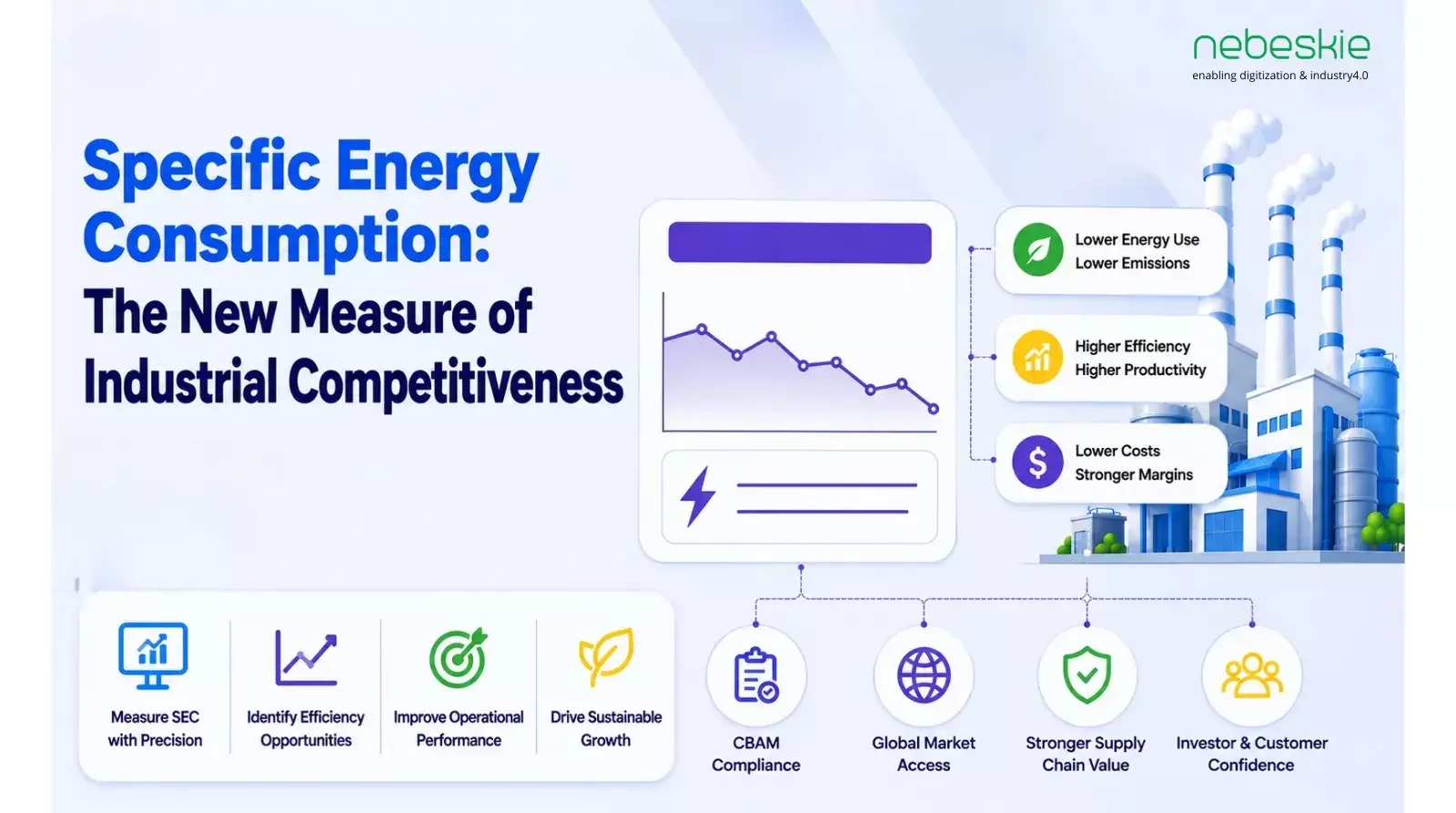
For the better part of two decades, corporate sustainability conversations have revolved around emissions. Scope 1. Scope 2. Scope 3. Net-zero roadmaps. Carbon disclosures. Science-based targets. Yet beneath these headline metrics lies a more fundamental question: How much energy does it take to produce what you sell? As global climate regulations mature and carbon costs become embedded in international trade, Specific Energy Consumption (SEC)—the energy required to produce a unit of output—is emerging as one of the most important operational and strategic metrics in industry.
In boardrooms, sustainability is often discussed as a reporting challenge. Increasingly, however, regulators, customers, and investors are treating it as a competitiveness challenge. And competitiveness starts with productivity. In a carbon-constrained economy, energy productivity may prove just as important as labor productivity or capital productivity. The companies that understand this shift are moving beyond annual emissions disclosures and focusing on the operational foundations that determine those emissions in the first place.
The Regulatory Conversation Is Quietly Shifting
Historically, environmental regulation focused on what organizations emitted. The next generation of regulations is focused on how products are made. The European Union's Carbon Border Adjustment Mechanism (CBAM) is perhaps the clearest example. CBAM requires importers of certain carbon-intensive goods to report embedded emissions and, under its definitive regime beginning in 2026, surrender carbon certificates linked to those emissions. The mechanism currently covers sectors such as steel, cement, aluminum, fertilizers, hydrogen, and electricity. The significance of CBAM extends well beyond Europe. For the first time at scale, carbon performance is becoming a factor in international trade competitiveness. Producers are no longer competing solely on quality, reliability, and price. Increasingly, they are competing on the carbon intensity embedded within their products. This changes the strategic discussion entirely. The question is no longer, "Can we produce this product?" It becomes, "Can we produce it more efficiently—and with lower embedded emissions—than our competitors?" SEC sits at the center of that question.
Why Specific Energy Consumption Matters More Than Emissions Alone
Emissions metrics are important, but they are ultimately outcomes. SEC measures the operational drivers that create those outcomes. Consider two manufacturing facilities with identical annual electricity consumption. On paper, they appear comparable. Yet if one facility produces twice the output of the other, its specific energy consumption is dramatically lower. It generates more economic value from every unit of energy consumed. That distinction matters because SEC simultaneously influences production costs, carbon intensity, exposure to carbon pricing, resource efficiency, supply-chain attractiveness, long-term profitability. In many industries, energy represents one of the largest controllable costs. As energy markets become more volatile and carbon regulations become more stringent, inefficient operations will face pressure from both directions: higher operating costs and higher compliance costs. Organizations that reduce SEC achieve a rare outcome in business: they improve financial performance and sustainability performance at the same time.
The Hidden Weakness in Most Sustainability Programs
Many organizations are investing heavily in carbon reporting systems while paying insufficient attention to energy measurement infrastructure. The result is predictable. Executives receive annual emissions inventories but lack visibility into the operational drivers behind those numbers. In many industrial environments, energy data still exists primarily at the facility level—captured through utility bills or main-meter readings. While sufficient for reporting purposes, this level of aggregation provides limited insight into where inefficiencies actually occur. A plant manager rarely makes decisions at the facility level. Decisions are made at the level of process lines, production shifts, equipment assets, product families, and individual facilities. Without granular energy monitoring, SEC becomes difficult to calculate accurately and even harder to improve systematically. Organizations end up treating emissions as a compliance exercise rather than an operational performance opportunity.
CBAM Is Revealing a New Competitive Divide
One of the most important lessons emerging from CBAM implementation is that not all emissions data are created equally. Some companies can demonstrate actual energy consumption and embedded emissions using detailed operational records. Others rely heavily on estimates, secondary emission factors, or generalized assumptions. As regulators demand greater transparency and verification, this distinction becomes increasingly consequential. CBAM's reporting requirements are steadily pushing companies toward more accurate measurement methodologies and greater visibility into embedded emissions. This creates two categories of organizations, those that can prove performance and those that can only approximate it. Over time, the first group is likely to enjoy significant advantages—in compliance with costs, customer trust, market access, and competitive positioning.
From Carbon Reporting to Carbon Productivity
Perhaps the most important strategic shift for business leaders is recognizing that sustainability is evolving from a disclosure issue to a productivity issue. For years, organizations focused on measuring tons of CO₂ emitted. The next decade will increasingly focus on measuring value created per unit of energy consumed and emissions generated. This is a fundamentally different management challenge.
Leading organizations are beginning to ask questions such as:
- Which products have the lowest energy intensity?
- Which production lines consume disproportionate amounts of energy?
- How does SEC vary across facilities?
- Where are efficiency investments delivering measurable returns?
- How does our energy performance compare with industry benchmarks?
These questions move sustainability from the ESG function into core operational strategy, and that is where real competitive advantage is created.
The Leadership Imperative
The temptation is to view SEC as a technical metric relevant only to energy managers and plant engineers. That would be a mistake. In a world increasingly shaped by CBAM, climate disclosure requirements, supply-chain transparency expectations, and investor scrutiny, SEC is becoming a leading indicator of industrial resilience. The organizations that succeed will not necessarily be those with the most ambitious climate targets. They will be the organizations with the clearest operational understanding of how energy flows through their business. Because ultimately, decarbonization is not a reporting exercise. It is an efficiency exercise and in the emerging carbon economy, specific energy consumption may become the most important number many executives are not yet paying enough attention to.