
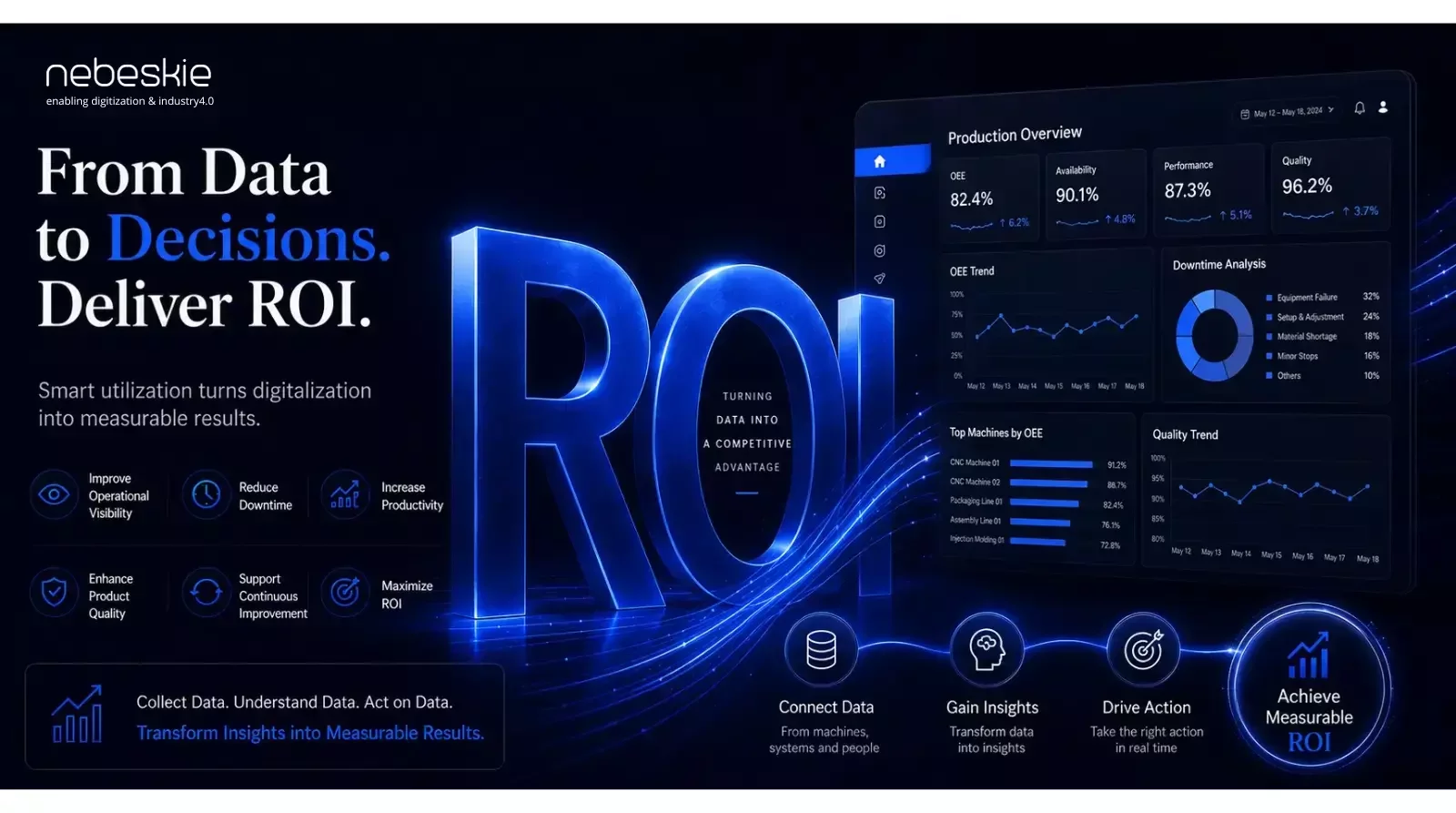
The Digitalization Investment Dilemma
Manufacturers worldwide are investing heavily in Industry 4.0 technologies, connected machines, Manufacturing Execution Systems (MES), Industrial IoT platforms, and real-time data infrastructure. The objective is clear: improve productivity, reduce downtime, increase operational visibility, enhance quality, and drive measurable business outcomes.
However, despite significant investments, many organizations struggle to achieve the expected return on investment (ROI). While technology adoption continues to accelerate, the anticipated gains in efficiency and profitability often remain unrealized. The reason is rarely the technology itself.
The real challenge lies in how effectively organizations utilize the data generated by their digital systems. Digitalization creates a foundation for improvement, but true value emerges only when data is transformed into insights, actions, and continuous operational improvements.
Simply collecting data does not generate ROI. The ability to interpret, analyze, and act on that data is what determines whether digital transformation succeeds or fails.
Data Collection Alone Doesn't Deliver Results
A common misconception in manufacturing is that connecting machines and capturing production data automatically leads to operational excellence.
Many manufacturers collect enormous volumes of information from machines, sensors, operators, and production systems but struggle to convert that information into meaningful business intelligence.
Common challenges include:
Data stored across disconnected systems
Limited visibility into production bottlenecks
Delayed decision-making caused by manual reporting
Inconsistent data across departments
Difficulty identifying root causes of quality and performance issues
Lack of actionable insights for operators and managers
Time-consuming compliance and audit preparation
As a result, valuable information remains underutilized. Teams spend more time searching for data than acting on it. When operational data is not effectively used, digitalization becomes an expense rather than a strategic advantage.
The Difference Between Digitalization and Digital Utilization
Many organizations focus on digitalization, but fewer focus on digital utilization. Digitalization refers to collecting and digitizing operational information from machines, processes, quality systems, and production activities. Digital utilization refers to transforming that information into actions that improve business performance.
This includes:
Monitoring production performance in real time
Identifying equipment inefficiencies before they affect output
Tracking Overall Equipment Effectiveness (OEE)
Improving quality through data-driven analysis
Benchmarking critical production parameters
Comparing desired versus actual performance
Conducting root cause analysis
Automating compliance reporting
Supporting faster operational decisions
The manufacturers achieving the highest ROI are not necessarily collecting more data. They are utilizing existing data more effectively to drive measurable improvements.
Why Smart Utilization Drives ROI
Every manufacturing operation generates valuable information across machines, operators, materials, processes, quality systems, and enterprise applications. When this information is connected, contextualized, and analyzed, manufacturers gain powerful opportunities to improve performance.
1. Improve Operational Visibility
Real-time dashboards provide immediate visibility into production status, machine utilization, work-in-progress, quality metrics, and process performance. Instead of waiting for end-of-shift or end-of-day reports, supervisors and managers can identify issues as they occur and take corrective action immediately. This proactive approach reduces delays and improves responsiveness across operations.
2. Reduce Downtime
Unplanned downtime is one of the largest hidden costs in manufacturing. By continuously monitoring machine performance and operational parameters, manufacturers can identify abnormalities before they result in equipment failures. Early detection allows maintenance teams to address issues proactively, reducing downtime and improving asset availability.
3. Increase Productivity
Operational data helps manufacturers identify production bottlenecks, process inefficiencies, and resource constraints. With accurate visibility into production performance, organizations can optimize workflows, improve scheduling, and increase throughput without additional capital investment.
4.Enhance Product Quality
Quality improvements become more achievable when production and quality data are analyzed together. Manufacturers can identify trends, detect deviations earlier, reduce defects, and maintain greater consistency across products and production runs. Improved quality leads to reduced scrap, lower rework costs, and higher customer satisfaction
5.Support Continuous Improvement
Continuous improvement initiatives rely on accurate and reliable information. Digital systems provide objective data that enable teams to make fact-based decisions instead of relying on assumptions or incomplete information. This creates a culture of measurable and sustainable operational improvement
Critical Parameter Benchmarking: Turning Data into Process Excellence
One of the most powerful yet often overlooked applications of digital manufacturing systems is critical parameter benchmarking. Every manufacturing process contains key variables that directly impact quality, efficiency, and product performance.
Examples include:
Temperature
Pressure
Cycle time
Torque
Machine speed
Feed rate
Energy consumption
Material characteristics
By continuously monitoring these parameters, manufacturers can establish benchmarks based on optimal production conditions.
Benefits of critical parameter benchmarking include:
Improved process stability
Reduced production variability
Better product consistency
Faster identification of process deviations
Replication of best-performing production runs
Increased operational efficiency
Instead of reacting to problems after they occur, manufacturers can proactively maintain optimal operating conditions.
Desired vs. Actual Performance Analysis
Digital transformation becomes significantly more valuable when organizations compare expected performance with actual operational outcomes. Desired versus actual analysis provides visibility into performance gaps and improvement opportunities.
Manufacturers can compare:
Planned vs. actual production output
Target vs. actual OEE
Standard vs. actual cycle times
Expected vs. actual machine utilization
Planned vs. actual delivery schedules
Quality targets vs. actual defect rates
These comparisons help leaders understand where performance is falling short and where corrective action is required. By continuously measuring performance against targets, organizations can prioritize improvement efforts and maximize operational effectiveness.
Root Cause Analysis (RCA): Solving Problems Permanently
Many organizations spend significant time addressing recurring issues without understanding their true causes. Root Cause Analysis (RCA) transforms manufacturing data into actionable intelligence by identifying why problems occur. Modern MES and shop floor data platforms can correlate information across:
Machines
Operators
Materials
Production orders
Quality systems
Maintenance records
This enables manufacturers to:
Investigate downtime events
Identify sources of quality defects
Analyze recurring production losses
Understand process deviations
Implement corrective and preventive actions (CAPA)
Instead of repeatedly treating symptoms, organizations can eliminate the underlying causes of operational issues. This leads to sustainable improvements and significantly higher ROI from digital investments.
Compliance Reporting and Audit Readiness
For many manufacturers, operational excellence extends beyond productivity and quality. Regulatory compliance, customer audits, industry standards, and traceability requirements are increasingly important across industries such as aerospace, automotive, pharmaceuticals, food processing, heavy engineering, and industrial equipment manufacturing. Traditional compliance management often relies on manual documentation, spreadsheets, and paper-based records.
This approach creates challenges such as:
Incomplete records
Data inconsistencies
Time-consuming audits
Increased compliance risk
Limited traceability
Digital manufacturing platforms simplify compliance management by automatically capturing and storing production information in real time.
Benefits include:
1. Automated Compliance Reporting
Production, quality, maintenance, and process records can be automatically compiled into compliance reports, reducing administrative effort and improving accuracy.
2. End-to-End Traceability
Manufacturers can track materials, processes, machine parameters, operator actions, and quality results throughout the production lifecycle.
This enables complete product genealogy and faster issue resolution.
3.Faster Audit Preparation
Instead of spending days or weeks gathering documentation, organizations can access complete digital records instantly.
This significantly reduces audit preparation time.
4. Improved Regulatory Adherence
Digital systems help ensure processes are executed according to defined standards and procedures, reducing the risk of non-compliance.
5. Increased Customer Confidence
Customers increasingly expect transparency, traceability, and quality assurance. Audit-ready digital records demonstrate operational maturity and strengthen customer trust.
Organizations that maintain continuous audit readiness not only reduce compliance risks but also improve overall operational discipline and accountability.
The Role of MES and Shop Floor Data Infrastructure
A robust Manufacturing Execution System (MES) combined with a connected shop floor data infrastructure plays a critical role in maximizing digitalization ROI.
These platforms enable manufacturers to:
Collect real-time data from machines and production processes
Standardize information across departments
Monitor production performance continuously
Benchmark critical process parameters
Conduct desired versus actual performance analysis
Support root cause investigations
Enable traceability and compliance reporting
Deliver actionable insights to decision-makers
Most importantly, MES solutions bridge the gap between Operational Technology (OT) and Information Technology (IT), ensuring critical information reaches the right people at the right time.
This connection transforms raw production data into business intelligence that drives measurable results.
The Human Factor Matters
Technology alone cannot guarantee success. Even the most advanced digital platform will fail to deliver value if employees do not adopt it effectively.
Successful digital transformation requires:
Clear business objectives
Executive sponsorship
User-friendly workflows
Employee training
Change management programs
Cross-functional collaboration
Continuous performance measurement
When operators, supervisors, engineers, quality teams, and executives work from the same trusted source of information, decision-making becomes faster, more accurate, and more impactful.
Turning Digital Investments into Business Outcomes
Manufacturers often evaluate digitalization projects based on technical capabilities. However, the true measure of success is business impact.
Leaders should ask:
Are we reducing downtime?
Are we increasing production efficiency?
Are we improving OEE?
Are we enhancing product quality?
Are we benchmarking critical parameters effectively?
Are we identifying root causes faster?
Are we reducing manual reporting efforts?
Are we improving compliance readiness?
Are we preparing for audits more efficiently?
Are we making faster operational decisions?
Are we increasing customer satisfaction?
If the answer is yes, digitalization is delivering measurable ROI.
Conclusion
The future of manufacturing belongs to organizations that do more than collect data—they use it intelligently. Digitalization creates the foundation, but smart utilization creates the value. Manufacturers that leverage operational data for real-time visibility, critical parameter benchmarking, desired-versus-actual performance analysis, root cause investigation, compliance reporting, and audit readiness gain a significant competitive advantage.
These organizations achieve:
Greater operational visibility
Reduced downtime
Higher productivity
Improved quality
Stronger compliance
Better decision-making
Increased profitability
In an increasingly competitive manufacturing environment, success will not be determined by how much data is collected, but by how effectively that data is transformed into actionable intelligence. The ROI of digitalization ultimately depends on smart utilization.
Ready to Unlock More Value from Your Manufacturing Data?
Evaluate how your organization currently uses operational data and identify opportunities to improve visibility, efficiency, compliance, and decision-making. The greatest returns often come not from collecting more data, but from making smarter use of the data you already have.