
Introduction
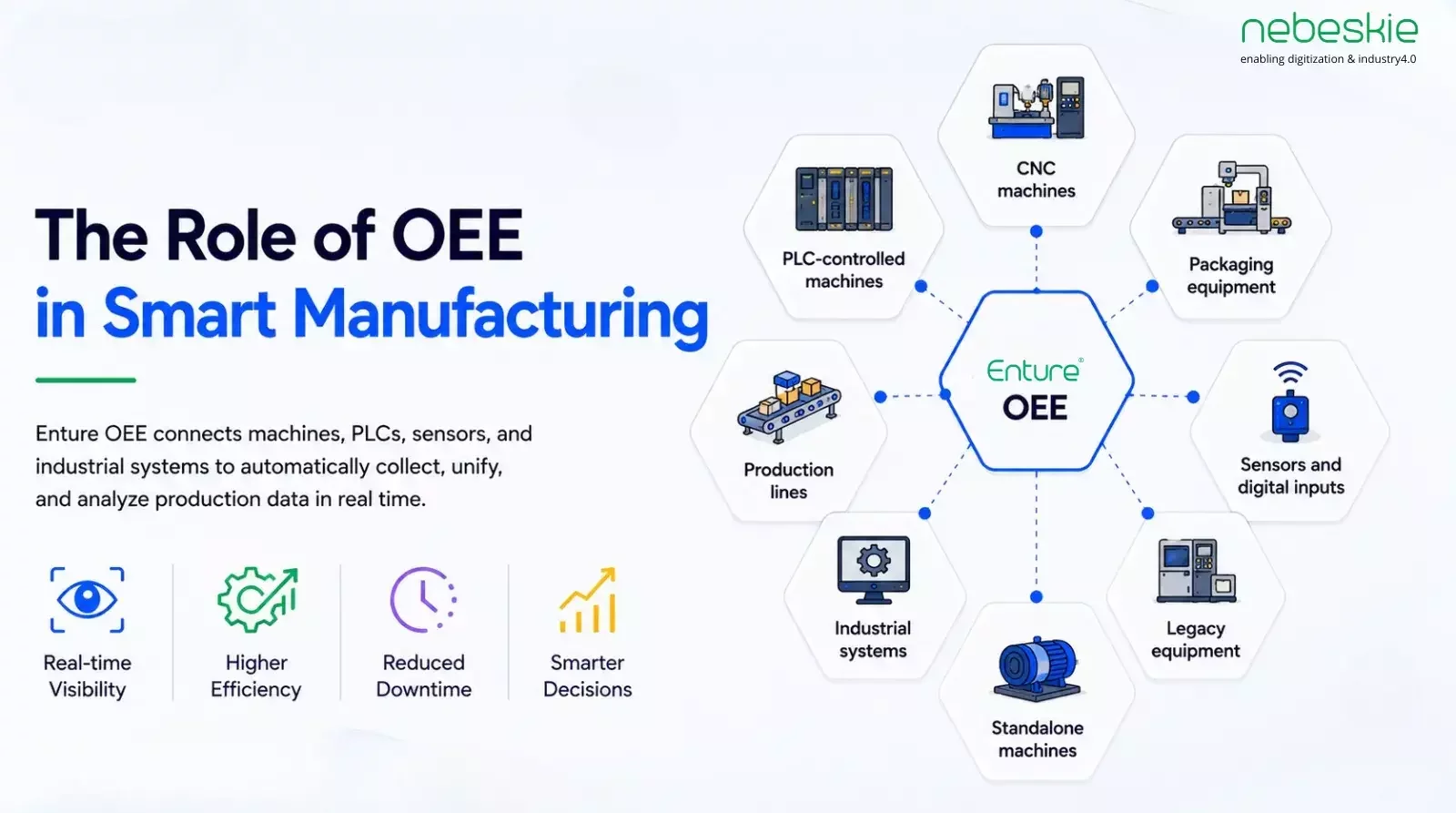
Manufacturing environments are becoming increasingly connected, but many factories still operate with a mix of modern and legacy machines. CNC machines, PLC-controlled equipment, production lines, packaging machines, and standalone assets may all use different technologies, communication protocols, and data formats.
This creates a common challenge for manufacturers:
How can you collect reliable production data from different machines and bring it into one connected OEE system?
Traditional production monitoring often depends on operators manually recording production quantities, downtime, machine status, and quality information. This process can be time-consuming and inconsistent. It can also make it difficult for production teams to understand what is happening on the shop floor in real time.
Enture OEE helps manufacturers move beyond manual production reporting by automating machine data collection and transforming production data into real-time performance insights.
By connecting machines, PLCs, sensors, and industrial systems, Enture OEE enables manufacturers to monitor key production metrics such as Availability, Performance, Quality, production quantity, downtime, and cycle time. The result is a more connected production environment where teams can identify losses faster, understand machine performance, and make better operational decisions.
Why Automated Data Collection Matters for OEE
Overall Equipment Effectiveness (OEE) is a widely used metric for measuring how effectively manufacturing equipment is being utilized.
OEE is generally calculated using three key factors:
Availability
Is the machine available and running when it should be?
Availability helps manufacturers understand the impact of downtime and machine stoppages on production.
Performance
Is the machine operating at its expected speed?
Performance identifies losses caused by slow cycles, reduced operating speeds, and minor stoppages.
Quality
Is the machine producing good products without defects?
Quality measures the proportion of good products compared with the total production output.
Accurate OEE depends on accurate and timely production data.
When machine information is manually entered at the end of a shift, important production events can be missed or recorded incorrectly. Short stoppages may not be captured, downtime reasons may be inaccurate, and actual cycle times may differ from reported values.
With Enture OEE, manufacturers can automate the collection of machine and production data, helping teams move from delayed production reports to real-time visibility. This allows production teams to identify performance deviations while production is still running instead of discovering problems after the shift has ended.
How Enture OEE Collects Data from Different Machines
Modern manufacturing environments often include machines from multiple vendors, different generations of equipment, and a combination of automated and manual processes.
Enture OEE is designed to support this type of connected manufacturing environment by bringing machine and production data together through an industrial data architecture.
The process can be understood through several key stages.
1. Connect Different Machines and Equipment
The first step in implementing OEE is connecting machines to a common data environment. A modern factory may have equipment from different manufacturers and different generations. Some machines may have modern network interfaces, while older machines may provide data through PLCs, sensors, control systems, or other industrial interfaces. Enture's industrial connectivity approach helps manufacturers connect different sources of shop-floor data, including:
PLC-controlled machines
CNC machines
Production lines
Packaging equipment
Sensors and digital inputs
Industrial systems
Legacy equipment
Standalone machines
This enables manufacturers to bring data from heterogeneous production environments into a connected OEE ecosystem without requiring every machine to be replaced or upgraded.
For factories that have expanded their production infrastructure over many years, this connectivity is essential for creating a unified view of machine and production performance.
2. Collect Machine Data Automatically
Once machines are connected, Enture OEE can collect relevant production information automatically.
Depending on the machine and production process, this may include:
Machine running status
Machine idle status
Downtime events
Production counts
Good and rejected quantities
Cycle times
Fault and alarm conditions
Production start and stop times
Planned downtime
Unplanned downtime
Instead of relying entirely on operators to record every event manually, machine data can be collected automatically from connected equipment. This creates a more consistent and timely source of production information. With automated data collection, production teams can spend less time on repetitive manual reporting and more time focusing on production improvement.
3. Use Enture Edge Connectivity to Bring Data Together
One of the biggest challenges in manufacturing is that machine data often exists across different systems, devices, and formats. This is where an edge-based connectivity architecture can play an important role. Enture Edge OS acts as a foundation for connecting industrial devices and systems, collecting data, normalizing information, and securely routing it to the appropriate applications and platforms. A typical data flow can be represented as:
Machines & PLCs → Enture Edge OS → Data Normalization → Enture OEE → Dashboards & Analytics
This architecture helps create a common data layer across different machines and production lines. Instead of developing separate data collection systems for every machine, manufacturers can establish a more centralized approach to collecting and managing industrial data. This is particularly valuable for factories that operate a combination of new and legacy equipment.
With a connected architecture, manufacturers can move from fragmented machine data toward a unified view of production performance.
4. Automatically Detect Machine Downtime
Downtime is one of the most important factors affecting OEE. With automated machine data collection, Enture OEE can help identify when equipment changes from a running state to a stopped or idle state. The system can capture important downtime information such as:
When the machine stopped
How long the machine remained stopped
When production restarted
Frequency of downtime events
Recurring machine stoppages
Planned and unplanned downtime
Where human input is required, operators can assign or confirm the appropriate downtime reason. For example, instead of simply seeing: Machine stopped for 45 minutes Production teams can gain greater visibility into the reasons behind the loss:
15 minutes – Material shortage
10 minutes – Changeover
8 minutes – Machine fault
7 minutes – Quality inspection
5 minutes – Other
This level of visibility helps manufacturers understand where production losses are occurring. By identifying recurring downtime patterns, teams can focus improvement initiatives on the biggest sources of production loss.
5. Calculate OEE in Real Time
Instead of waiting until the end of a shift or production day to calculate performance, teams can monitor production performance while operations are still running. Real-time OEE visibility helps supervisors and managers quickly identify:
Underperforming machines
Repeated downtime
Production losses
Slow-running equipment
Bottlenecks
Production deviations
This allows teams to respond faster and take corrective action before small issues become larger production problems.
6. Combine Automated Data with Operator Input
Not every production data point can always be collected directly from a machine. For example, certain information may still require operator input, such as:
Specific downtime reasons
Quality rejection reasons
Changeover details
Production comments
Other contextual information
Enture OEE can support a combination of automated machine data and operator inputs. This creates a hybrid approach:
Automated Machine Data + Operator Input + Production Information
The system can automatically capture objective machine events while allowing operators to provide additional context where required. This creates a more complete picture of production performance and helps manufacturers better understand the reasons behind production losses.
Why Connecting Different Machines Is the Real Challenge
The biggest challenge in OEE implementation is often not the OEE calculation itself. The real challenge is getting reliable data from every machine into one connected system.
A typical factory may have:
Different PLC brands
Different communication protocols
New and legacy machines
Standalone equipment
Separate production systems
Manual processes
This creates fragmented data across the shop floor. A scalable OEE architecture therefore needs to focus on connectivity and data standardization before analytics.
The objective is to create a reliable flow of information:
Connect → Collect → Normalize → Analyze → Act With Enture Edge OS helping establish the industrial data foundation and Enture OEE turning production data into actionable performance insights, manufacturers can move toward a more connected approach to production management.
Enture OEE and Industry 4.0
OEE is becoming an important part of the broader Industry 4.0 strategy. However, OEE should not operate as an isolated performance number. When production data is connected with other operational information, manufacturers can build a broader view of factory performance. For example, OEE data can be combined with:
Energy consumption
Machine condition
Maintenance information
Quality data
Production schedules
Environmental conditions
Utility consumption
This creates opportunities to understand how different factors influence production performance. For example, manufacturers can begin to explore questions such as:
Is energy consumption increasing when production performance decreases?
Are certain machine conditions contributing to downtime?
Which production lines consistently perform below target?
Which recurring downtime events are creating the largest production losses?
The future of manufacturing is not simply about collecting more data. It is about connecting the right data sources and turning that information into actionable intelligence.
How Enture OEE Helps Manufacturers Move from Data to Decisions
Manufacturers need more than production data. They need timely insights that help them understand what is happening on the shop floor and take action. With Enture OEE, manufacturers can build a connected approach to production performance monitoring by combining automated machine data collection, OEE calculations, downtime analysis, and real-time visibility.
Enture's industrial data architecture helps organizations:
Connect different industrial devices and systems
Collect machine and production data
Normalize data from multiple sources
Securely route industrial data
Monitor production performance
Track OEE in real time
Analyze downtime and production losses
Build centralized operational visibility
Support data-driven continuous improvement
This helps manufacturers move from fragmented machine data to a more connected and intelligent production environment.
Ready to Move from Manual Production Data to Real-Time OEE Visibility?
OEE software is evolving from a simple reporting tool into an important part of the connected factory. The ability to automatically collect data from different machines allows manufacturers to reduce manual reporting, improve data accuracy, monitor production in real time, and identify the root causes of performance losses.
However, successful OEE implementation starts with reliable machine connectivity. When machines, PLCs, sensors, and industrial systems can communicate through a common data architecture, manufacturers gain a stronger foundation for real-time OEE monitoring and broader Industry 4.0 initiatives. Enture OEE helps manufacturers connect production data with performance insights—so teams can move beyond manual reporting, understand production losses, and make faster, data-driven decisions. The goal is not just to calculate OEE. The goal is to connect machine data, understand production losses, improve equipment effectiveness, and turn real-time information into better operational decisions.